
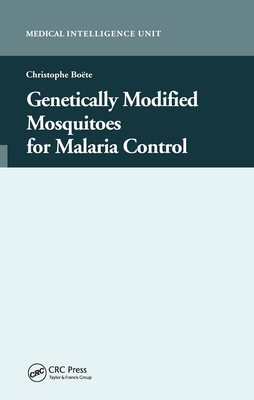
Genetically Modified Mosquitoes for Malaria Control
Book Details
Format
Paperback / softback
ISBN-10
0367446308
ISBN-13
9780367446307
Publisher
Taylor & Francis Ltd
Imprint
CRC Press
Country of Manufacture
GB
Country of Publication
GB
Publication Date
Dec 3rd, 2019
Print length
174 Pages
Weight
453 grams
Product Classification:
OncologyBiology, life sciences
KSh 12,400.00
Currently unavailable
0 in stock
Delivery Location
Delivery fee: Select location
Secure
Quality
Fast
This book describes the epidemiological and evolutionary consequences of the use of genetically modified (GM) mosquitoes as well as research orientations and ethical issues concerning the use of GM mosquitoes. It also includes discussion on transgenic mosquitoes for malaria control.
Despite a century of research and attempts to control one of the deadliest foes of mankind, the malaria situation remains a major public health problem. Obviously biological explanations (the resistance of parasites and mosquitoes against available drugs and insecticides respectively) are often given, but they remain partial and incomplete. Indeed, the deterioration of socio-economic conditions due to the policies imposed on many developing countries by international financial institutions, such as the structural adjustment programmes and the mechanism of debt, plays an important role in the malaria situation and its evolution.
In the last decade, molecular biology has been a source of great hope for creating genetically-modified mosquitoes able to resist the malaria parasite. If technical progress permits confidence in the creation of such non-vectors, many questions remain open concerning the putative success of their deployment and the resultant reduction of malaria transmission. Indeed the understanding of the coevolutionary processes underlying malaria/mosquito interactions is crucially lacking despite its enormous importance. Moreover, when discussing transgenic mosquitoes, one critical point is the spread of the allele conferring resistance in mosquito populations ensuring the replacement of a or several populations of vectors able to transmit malaria by (theoretically) unable one(s). However, invading a whole population of mosquitoes with a transgene (composed with an allele conferring malaria-resistance and a driving system) is unlikely to be an easy task, it will at least depend on the population structure and on the quality of the driver. Alongside this, it appears that the spread of refractoriness itself is necessary but not sufficient as interactions between the allele of interest, the parasite and the environment may affect refractoriness and thus limit the expected success in terms of malaria control. Indeed the aim of a release of transgenic mosqui
In the last decade, molecular biology has been a source of great hope for creating genetically-modified mosquitoes able to resist the malaria parasite. If technical progress permits confidence in the creation of such non-vectors, many questions remain open concerning the putative success of their deployment and the resultant reduction of malaria transmission. Indeed the understanding of the coevolutionary processes underlying malaria/mosquito interactions is crucially lacking despite its enormous importance. Moreover, when discussing transgenic mosquitoes, one critical point is the spread of the allele conferring resistance in mosquito populations ensuring the replacement of a or several populations of vectors able to transmit malaria by (theoretically) unable one(s). However, invading a whole population of mosquitoes with a transgene (composed with an allele conferring malaria-resistance and a driving system) is unlikely to be an easy task, it will at least depend on the population structure and on the quality of the driver. Alongside this, it appears that the spread of refractoriness itself is necessary but not sufficient as interactions between the allele of interest, the parasite and the environment may affect refractoriness and thus limit the expected success in terms of malaria control. Indeed the aim of a release of transgenic mosqui
Get Genetically Modified Mosquitoes for Malaria Control by Christophe Boete at the best price and quality guaranteed only at Werezi Africa's largest book ecommerce store. The book was published by Taylor & Francis Ltd and it has 174 pages.
Customers Who Bought This Also Bought

The Emperor of All Maladies
KSh 2,350.00

The Cancer Whisperer
KSh 2,350.00

Core Curriculum for Oncology Nursing
KSh 15,150.00

Modeling Cancer Progression and the Effects of Treatment
KSh 21,950.00

Virtually Virgins – Sexual Strategies and Cervical Cancer in Recife, Brazil
KSh 3,800.00

Tumors of the Lymph Nodes and Spleen
KSh 37,950.00

Health Advocacy, Inc. – How Pharmaceutical Funding Changed the Breast Cancer Movement
KSh 4,850.00
Breast Care Certification Review
KSh 13,700.00

Cancer Cytogenetics – Chromosomal and Molecular Genetic Aberrations of Tumor Cells 4e
KSh 25,550.00
Exploring Plant Cells for the Production of Compounds of Interest
KSh 36,000.00

Prostate Cancer Survivorship
KSh 16,200.00

Cancer Symptom Science
KSh 25,550.00
More by Christophe Boete
More in This Genre
The Emperor of All Maladies
KSh 2,350.00
The Cancer Whisperer
KSh 2,350.00
Core Curriculum for Oncology Nursing
KSh 15,150.00
Modeling Cancer Progression and the Effects of Treatment
KSh 21,950.00
Virtually Virgins – Sexual Strategies and Cervical Cancer in Recife, Brazil
KSh 3,800.00
Tumors of the Lymph Nodes and Spleen
KSh 37,950.00
