
Book Details
Format
Paperback / Softback
Book Series
Lecture Notes in Mathematics
ISBN-10
9811606870
ISBN-13
9789811606878
Edition
1st ed. 2021
Publisher
Springer Verlag, Singapore
Imprint
Springer Verlag, Singapore
Country of Manufacture
GB
Country of Publication
GB
Publication Date
Apr 24th, 2021
Print length
182 Pages
Weight
312 grams
Dimensions
15.70 x 23.60 x 1.50 cms
Ksh 7,200.00
Werezi Extended Catalogue
0 in stock
Delivery Location
Delivery fee: Select location
Secure
Quality
Fast
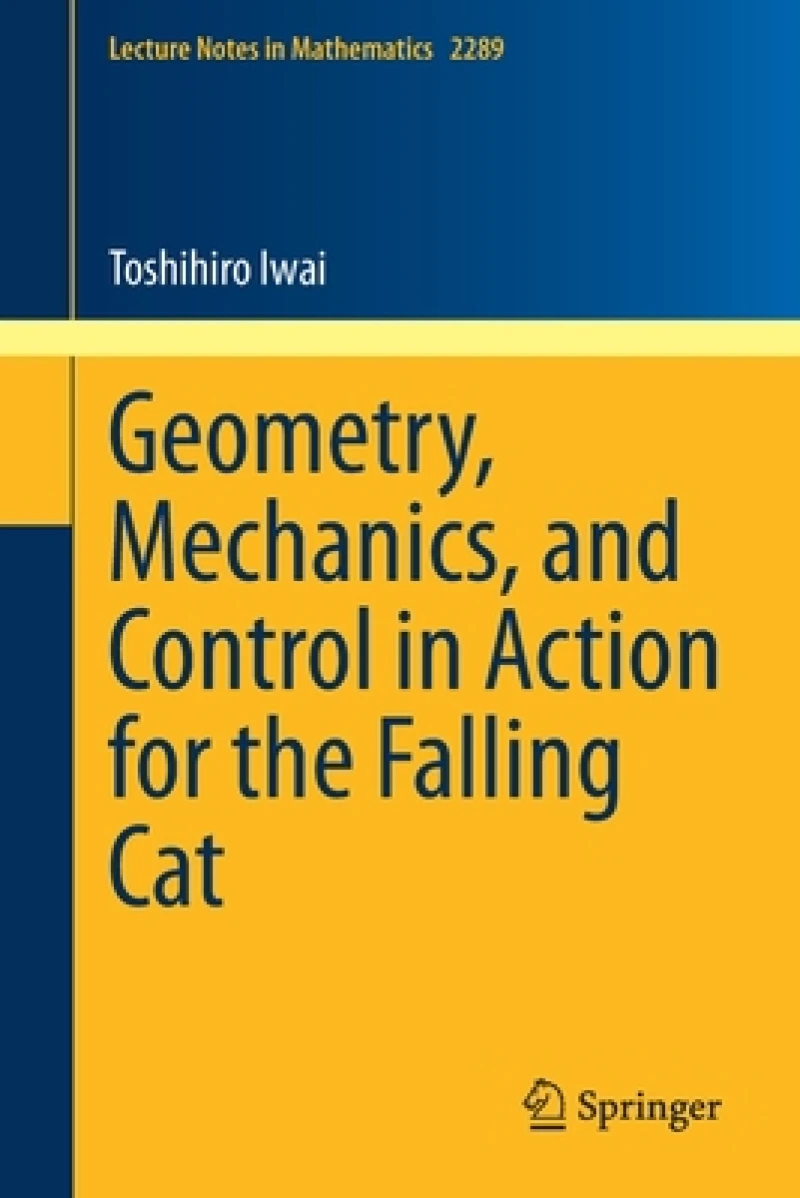
The falling cat is an interesting theme to pursue, in which geometry, mechanics, and control are in action together. As is well known, cats can almost always land on their feet when tossed into the air in an upside-down attitude. If cats are not given a non-vanishing angular momentum at an initial instant, they cannot rotate during their motion, and the motion they can make in the air is vibration only. However, cats accomplish a half turn without rotation when landing on their feet. In order to solve this apparent mystery, one needs to thoroughly understand rotations and vibrations. The connection theory in differential geometry can provide rigorous definitions of rotation and vibration for many-body systems. Deformable bodies of cats are not easy to treat mechanically. A feasible way to approach the question of the falling cat is to start with many-body systems and then proceed to rigid bodies and, further, to jointed rigid bodies, which can approximate the body of a cat.In this book, the connection theory is applied first to a many-body system to show that vibrational motions of the many-body system can result in rotations without performing rotational motions and then to the cat model consisting of jointed rigid bodies. On the basis of this geometric setting, mechanics of many-body systems and of jointed rigid bodies must be set up. In order to take into account the fact that cats can deform their bodies, three torque inputs which may give a twist to the cat model are applied as control inputs under the condition of the vanishing angular momentum. Then, a control is designed according to the port-controlled Hamiltonian method for the model cat to perform a half turn and to halt the motion upon landing. The book also gives a brief review of control systems through simple examples to explain the role of control inputs.
The falling cat is an interesting theme to pursue, in which geometry, mechanics, and control are in action together. As is well known, cats can almost always land on their feet when tossed into the air in an upside-down attitude. If cats are not given a non-vanishing angular momentum at an initial instant, they cannot rotate during their motion, and the motion they can make in the air is vibration only. However, cats accomplish a half turn without rotation when landing on their feet. In order to solve this apparent mystery, one needs to thoroughly understand rotations and vibrations. The connection theory in differential geometry can provide rigorous definitions of rotation and vibration for many-body systems. Deformable bodies of cats are not easy to treat mechanically. A feasible way to approach the question of the falling cat is to start with many-body systems and then proceed to rigid bodies and, further, to jointed rigid bodies, which can approximate the body of a cat. In this book, the connection theory is applied first to a many-body system to show that vibrational motions of the many-body system can result in rotations without performing rotational motions and then to the cat model consisting of jointed rigid bodies. On the basis of this geometric setting, mechanics of many-body systems and of jointed rigid bodies must be set up. In order to take into account the fact that cats can deform their bodies, three torque inputs which may give a twist to the cat model are applied as control inputs under the condition of the vanishing angular momentum. Then, a control is designed according to the port-controlled Hamiltonian method for the model cat to perform a half turn and to halt the motion upon landing. The book also gives a brief review of control systems through simple examples to explain the role of control inputs.
Get Geometry, Mechanics, and Control in Action for the Falling Cat by at the best price and quality guaranteed only at Werezi Africa's largest book ecommerce store. The book was published by Springer Verlag, Singapore and it has pages.

