
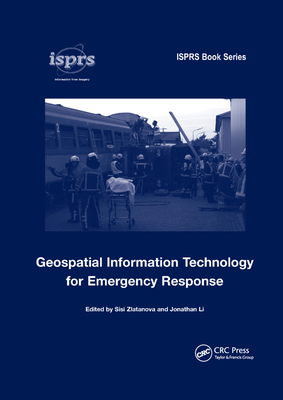
Geospatial Information Technology for Emergency Response
Book Details
Delivery Location
Delivery fee: Select location
Disaster management is generally understood to consist of four phases: mitigation, preparedness, response and recovery. While these phases are all important and interrelated, response and recovery are often considered to be the most critical in terms of saving lives. Response is the acute phase occurring after the event, and includes all arrangements to remove detriments and a long-term inventory of supplies to deal with irreversible damage. The timely provision of geospatial information is crucial in the decision-making process, and can save lives and rescue citizens.
The aim of this volume is to share technological advances that allow wider, faster and more effective utilization of geospatial information in emergency response situations. The volume describes current accomplishments and challenges in providing geospatial information with these attributes, and is organized in six parts:
- Practice and legislation, with a focus on the utilization of geospatial information in recent disaster events, as well as resulting legislative attempts to share and access data.
- Data collection and data products.
- Data management and routing in 3D.
- Emerging technologies, including positioning, virtual reality and simulation models.
- Integration of heterogeneous data.
- Applications and solutions.
This volume is aimed at researchers, practitioners and students who work in the variety of disciplines related to geospatial information technology for emergency response, and represents the very best of current thinking from a number of pioneering studies over the past four years.
Get Geospatial Information Technology for Emergency Response by Jonathan Li at the best price and quality guaranteed only at Werezi Africa's largest book ecommerce store. The book was published by Taylor & Francis Ltd and it has 394 pages.
Customers Who Bought This Also Bought

Genius of Trees
KSh 4,500.00
Genius of Trees
KSh 3,050.00
Genius of Trees
KSh 2,350.00
Recent Geotechnical Research at BOKU
KSh 27,000.00

An Introduction to the Study of Meteorites, Etc.
KSh 2,700.00

Intraterrestrials
KSh 2,900.00

Australia's Amazing Dinosaurs
KSh 2,050.00

Beyond Algorithms
KSh 22,500.00

Marsh Mud and Mummichogs
KSh 7,650.00

Marsh Mud and Mummichogs
KSh 4,600.00
Carbonate Depositional Systems
KSh 16,200.00
Crustal Heat Flow
KSh 12,950.00
