
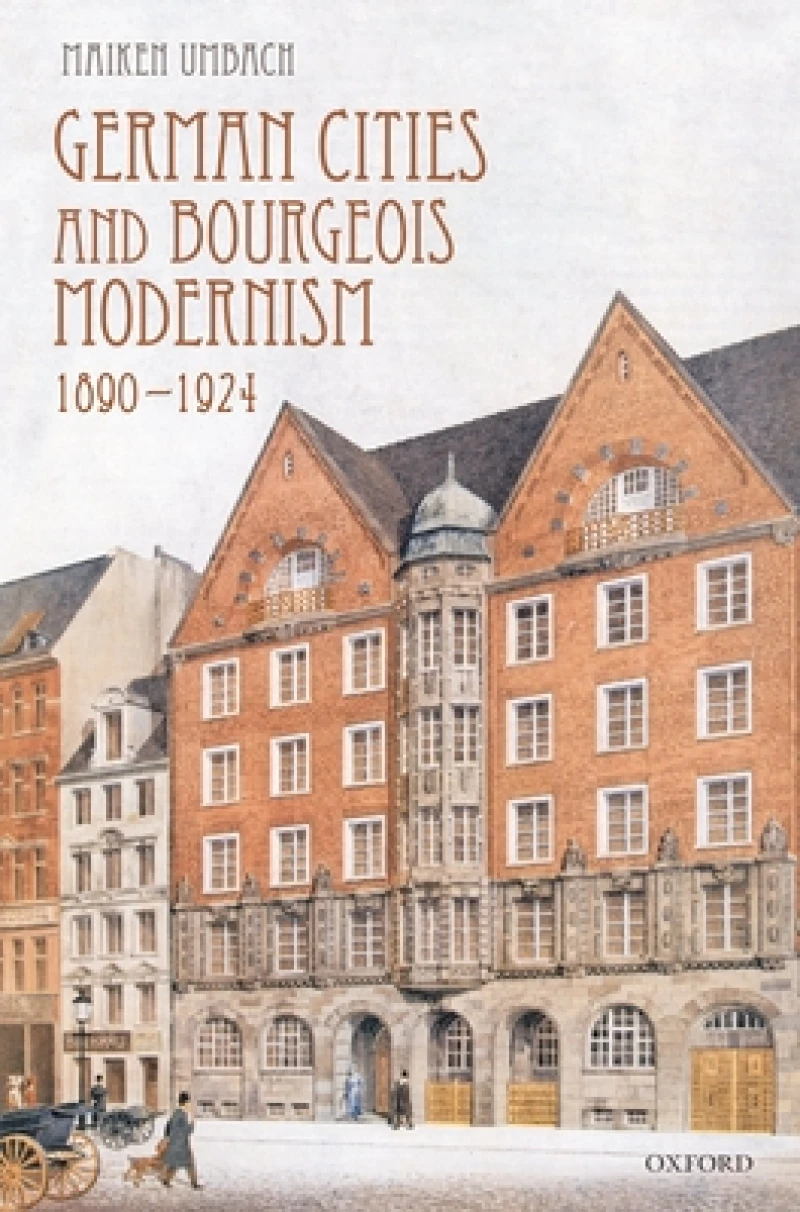
German Cities and Bourgeois Modernism, 1890-1924
Book Details
Format
Hardback or Cased Book
ISBN-10
019955739X
ISBN-13
9780199557394
Publisher
Oxford University Press
Imprint
Oxford University Press
Country of Manufacture
GB
Country of Publication
GB
Publication Date
Jun 25th, 2009
Print length
268 Pages
Weight
608 grams
Dimensions
24.00 x 16.10 x 1.70 cms
Ksh 21,850.00
Manufactured on Demand
0 in stock
Delivery Location
Delivery fee: Select location
Secure
Quality
Fast
A study of the distinctive brand of modernism that emerged in late 19th century Germany, illustrating through a series of analyses of key buildings and urban spaces how bourgeios modernism shaped the infrastructure of social and political life in the early twentieth century and transformed German cities.
This is a study of a distinctive brand of modernism that first emerged in late nineteenth-century Germany and remained influential throughout the inter-war years and beyond. Its supporters saw themselves as a new elite, ideally placed to tackle the many challenges facing the young and rapidly industrializing German nation-state. They defined themselves as bourgeois, and acted as self-appointed champions of a modern consciousness. Focusing on figures such as Hermann Muthesius, Fritz Schumacher, and Karl-Ernst Osthaus, and the activities of the Deutscher Werkbund and other networks of bourgeois designers, writers, and ''experts'', this book shows how bourgeois modernism shaped the infrastructure of social and political life in early twentieth-century Germany.Bourgeois modernism exercised its power not so much in the realm of ideas, but by transforming the physical environment of German cities, from domestic interiors, via consumer objects, to urban and regional planning. Drawing on a detailed analysis of key material sites of bourgeois modernism, and interpreting them in conjunction with written sources, this study offers new insights into the history of the bourgeois mindset and its operations in the private and public realms. Thematic chapters examine leitmotifs such as the sense of locality and place, the sense of history and time, and the sense of nature and culture. Yet for all its self-conscious progressivism, German bourgeois modernism was not an inevitable precursor of neo-liberal global capitalism. It remained a hotly contested historical construct, which was constantly re-defined in different geographical and political settings.
Get German Cities and Bourgeois Modernism, 1890-1924 by at the best price and quality guaranteed only at Werezi Africa's largest book ecommerce store. The book was published by Oxford University Press and it has pages.

