
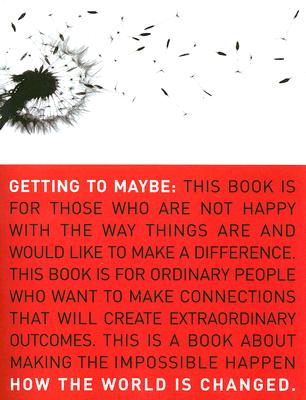
Getting to Maybe : How the World Is Changed
Book Details
Format
Paperback / softback
ISBN-10
067931444X
ISBN-13
9780679314448
Publisher
Random House USA Inc
Imprint
Random House Inc
Country of Manufacture
GB
Country of Publication
GB
Publication Date
Aug 7th, 2007
Print length
272 Pages
Weight
332 grams
Dimensions
17.90 x 22.80 x 2.70 cms
Product Classification:
Charities, voluntary services & philanthropyCharities, voluntary services and philanthropy
KSh 3,250.00
Werezi Extended Catalogue
Delivery in 12 days
1 copies in stock
Delivery Location
Delivery fee: Select location
Delivery in 12 days
Secure
Quality
Fast
A practical, inspirational, revolutionary guide to social innovation
Many of us have a deep desire to make the world around us a better place. But often our good intentions are undermined by the fear that we are so insignificant in the big scheme of things that nothing we can do will actually help feed the world’s hungry, fix the damage of a Hurricane Katrina or even get a healthy lunch program up and running in the local school. We tend to think that great social change is the province of heroes—an intimidating view of reality that keeps ordinary people on the couch. But extraordinary leaders such as Gandhi and even unlikely social activists such as Bob Geldof most often see themselves as harnessing the forces around them, rather than singlehandedly setting those forces in motion. The trick in any great social project—from the global fight against AIDS to working to eradicate poverty in a single Canadian city—is to stop looking at the discrete elements and start trying to understand the complex relationships between them. By studying fascinating real-life examples of social change through this systems-and-relationships lens, the authors of Getting to Maybe tease out the rules of engagement between volunteers, leaders, organizations and circumstance—between individuals and what Shakespeare called “the tide in the affairs of men.”
Getting to Maybe applies the insights of complexity theory and harvests the experiences of a wide range of people and organizations—including the ministers behind the Boston Miracle (and its aftermath); the Grameen Bank, in which one man’s dream of micro-credit sparked a financial revolution for the world’s poor; the efforts of a Canadian clothing designer to help transform the lives of Indigenous women and children; and many more—to lay out a brand new way of thinking about making change in communities, in business, and in the world.
Many of us have a deep desire to make the world around us a better place. But often our good intentions are undermined by the fear that we are so insignificant in the big scheme of things that nothing we can do will actually help feed the world’s hungry, fix the damage of a Hurricane Katrina or even get a healthy lunch program up and running in the local school. We tend to think that great social change is the province of heroes—an intimidating view of reality that keeps ordinary people on the couch. But extraordinary leaders such as Gandhi and even unlikely social activists such as Bob Geldof most often see themselves as harnessing the forces around them, rather than singlehandedly setting those forces in motion. The trick in any great social project—from the global fight against AIDS to working to eradicate poverty in a single Canadian city—is to stop looking at the discrete elements and start trying to understand the complex relationships between them. By studying fascinating real-life examples of social change through this systems-and-relationships lens, the authors of Getting to Maybe tease out the rules of engagement between volunteers, leaders, organizations and circumstance—between individuals and what Shakespeare called “the tide in the affairs of men.”
Getting to Maybe applies the insights of complexity theory and harvests the experiences of a wide range of people and organizations—including the ministers behind the Boston Miracle (and its aftermath); the Grameen Bank, in which one man’s dream of micro-credit sparked a financial revolution for the world’s poor; the efforts of a Canadian clothing designer to help transform the lives of Indigenous women and children; and many more—to lay out a brand new way of thinking about making change in communities, in business, and in the world.
Get Getting to Maybe by Brenda Zimmerman, Frances Westley at the best price and quality guaranteed only at Werezi Africa's largest book ecommerce store. The book was published by Random House USA Inc and it has 272 pages.
Customers Who Bought This Also Bought
Source Code
KSh 4,500.00

Winners Take All
KSh 2,350.00
How to Give – An Ancient Guide to Giving and Receiving
KSh 2,700.00
Fighting to Preserve a Nation's Soul
KSh 13,300.00

It's Like Heaven
KSh 6,300.00

Arts Legends Aotearoa
KSh 9,700.00

Books through Bars
KSh 7,550.00

Serving the Street
KSh 26,700.00

Serving the Street
KSh 5,750.00
The International Committee of the Red Cross
KSh 8,500.00
Missing Class
KSh 20,900.00

The Politics of Foundations
KSh 30,950.00
