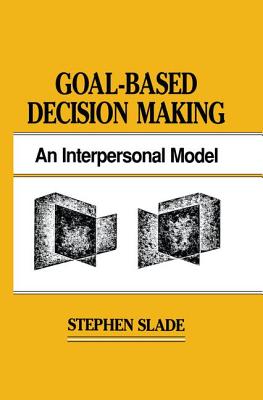
Goal-based Decision Making : An Interpersonal Model
Book Details
Format
Paperback / softback
ISBN-10
1138876410
ISBN-13
9781138876415
Publisher
Taylor & Francis Ltd
Imprint
Psychology Press Ltd
Country of Manufacture
GB
Country of Publication
GB
Publication Date
May 7th, 2015
Print length
300 Pages
Weight
430 grams
Product Classification:
Cognition & cognitive psychologyCognition and cognitive psychology
KSh 11,350.00
Currently unavailable
0 in stock
Delivery Location
Delivery fee: Select location
Secure
Quality
Fast
This work presents a goal-based model of decision making in which the relative priorities of goals drive the decision process -- a psychological alternative to traditional decision analysis. Building on the work of Schank and Abelson, the author uses goals as the basis for a model of interpersonal relations which permits decisions to incorporate personal and adopted goals in a uniform manner. The theory is modelled on the VOTE computer program which simulates Congressional roll-call voting decisions.
The VOTE program expands traditional decision making and simulation models by providing not only a choice, but also a natural language explanation, in either English or French. It simulates real members of Congress voting on real bills, and producing reasonable explanations. The program is consistent with much of the descriptive political science literature on Congressional decision making and provides an explicit model of political issues, relationships, and strategies that converge in voting behavior.
In developing the VOTE program, the author draws on his own practical experience in politics from four presidential campaigns and the White House. Given the underlying psychological basis of the program, VOTE can be extended to other decision making domains different from politics. Another use for the program is to simulate business decisions such as securities analysis, as well as mundane decision making such as choosing a college or deciding whether to get a Mohawk haircut.
The VOTE program expands traditional decision making and simulation models by providing not only a choice, but also a natural language explanation, in either English or French. It simulates real members of Congress voting on real bills, and producing reasonable explanations. The program is consistent with much of the descriptive political science literature on Congressional decision making and provides an explicit model of political issues, relationships, and strategies that converge in voting behavior.
In developing the VOTE program, the author draws on his own practical experience in politics from four presidential campaigns and the White House. Given the underlying psychological basis of the program, VOTE can be extended to other decision making domains different from politics. Another use for the program is to simulate business decisions such as securities analysis, as well as mundane decision making such as choosing a college or deciding whether to get a Mohawk haircut.
Get Goal-based Decision Making by Stephen Slade at the best price and quality guaranteed only at Werezi Africa's largest book ecommerce store. The book was published by Taylor & Francis Ltd and it has 300 pages.
Customers Who Bought This Also Bought

How Emotions Are Made
KSh 2,350.00

Gödel, Escher, Bach
KSh 4,200.00

Thinking, Fast and Slow
KSh 3,050.00

The Art of Seduction
KSh 5,050.00
Noise
KSh 2,000.00
Thinking, Fast and Slow
KSh 2,700.00

Seven and a Half Lessons About the Brain
KSh 2,000.00
Influence: Science and Practice
KSh 12,850.00

Do the Work
KSh 1,450.00

Thinking in Bets
KSh 5,050.00

Art Of Listening
KSh 3,050.00

Mind''s Eye
KSh 2,000.00