
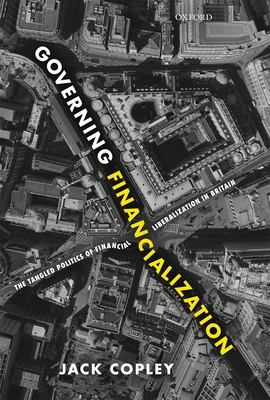
Governing Financialization : The Tangled Politics of Financial Liberalization in Britain
by
Jack Copley
Book Details
Format
Hardback
ISBN-10
0192897012
ISBN-13
9780192897015
Publisher
Oxford University Press
Imprint
Oxford University Press
Country of Manufacture
GB
Country of Publication
GB
Publication Date
Dec 7th, 2021
Print length
202 Pages
Weight
446 grams
Dimensions
16.30 x 24.20 x 1.80 cms
KSh 17,950.00
Currently unavailable
0 in stock
Delivery Location
Delivery fee: Select location
Secure
Quality
Fast
The book offers an alternative explanation of why the British state propelled radical financialization in the 1970s and 1980s.
Capitalism has become ''financialized''. Since the 1970s, the swelling of financial markets and asset price bubbles has occurred alongside weaker underlying economic growth. Yet financialization was not a spontaneous market development - it was deeply political. States fuelled this process through policies of financial liberalization, and the British state lies at the heart of the story. Britain''s radical financial liberalizations in the 1970s and 1980s were instrumental in creating a financialized global economic order in which the City of London emerged as a central hub. But why did the British state propel financialization? The conventional wisdom points to the lobbying power of financial elites and the strength of neoliberal ideology. However, Governing Financialization offers an alternative explanation through an in-depth exploration of declassified state archives. By examining key financial liberalizations in the 1970s and 1980s - including the notorious ''Big Bang'' - this book argues that these policies were not part of an intentional scheme to create a new finance-led economic model. Instead, they were designed to address immediate governing dilemmas related to the grinding ''stagflation'' crisis and its aftershocks. In this era, British governments found themselves trapped between global competitive pressures to enforce painful domestic adjustment and national political pressures to maintain existing living standards. Financial liberalization was pursued in a trial-and-error manner to navigate this dilemma. By unleashing financial markets, the state hoped to either postpone the worst effects of the crisis, or enact tough economic restructuring in an arm''s-length fashion. Financialization was an accidental outcome, not an intentional result.
Get Governing Financialization by Jack Copley at the best price and quality guaranteed only at Werezi Africa's largest book ecommerce store. The book was published by Oxford University Press and it has 202 pages.
Customers Who Bought This Also Bought

Age of Revolutions
KSh 2,350.00

How Civil Wars Start
KSh 2,000.00

Autobiography
KSh 2,350.00
The Origins of Political Order
KSh 2,700.00
Summer of Our Discontent
KSh 4,500.00
Political Order and Political Decay
KSh 2,700.00

Great Power Diplomacy
KSh 5,400.00

Summer of Our Discontent
KSh 2,350.00

Narrow Corridor
KSh 2,350.00

Israel’s Palestinians
KSh 4,700.00

Order and Region Making in the Middle East
KSh 17,100.00

Nasser's Blessed Movement
KSh 3,400.00
