
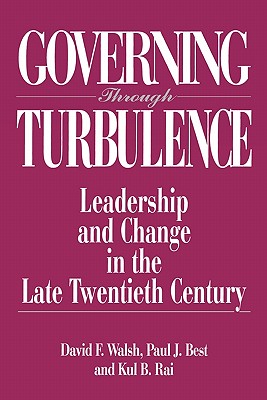
Governing Through Turbulence : Leadership and Change in the Late Twentieth Century
Book Details
Format
Paperback / softback
ISBN-10
0275951677
ISBN-13
9780275951672
Publisher
Bloomsbury Publishing Plc
Imprint
Praeger Publishers Inc
Country of Manufacture
GB
Country of Publication
GB
Publication Date
Aug 15th, 1995
Print length
264 Pages
Weight
420 grams
Dimensions
23.50 x 15.50 x 1.60 cms
KSh 6,800.00
Werezi Extended Catalogue
Delivery in 12 days
2 copies in stock
Delivery Location
Delivery fee: Select location
Delivery in 12 days
Secure
Quality
Fast
This study examines aspects of political leadership and governance in the last decades of the 20th century. It examines seven world leaders who assumed power in this time, and discusses issues such as the political-economic context and the leader's political programme.
This important study examines aspects of political leadership and governance in the last decades of the 20th century. Driven by innovations in science and technology, turbulent change has impacted nearly every political system and created a political environment of extreme complexity and fluidity. In this environment, previously dominant leaders, ideas, and institutions have been disempowered and new leaders and ideas empowered. This work examines seven world leaders, members of the first generation of political elites to assume power in the fluid political environment of the late 20th century. Two were heads of advanced industrial countries: Margaret Thatcher of the United Kingdom and Helmut Kohl of Germany. Three were leaders of states which underwent the transition from communist to postcommunist regimes: Lech Walesa of Poland, Mikhail Gorbachev of the Soviet Union, and Boris Yeltsin of Russia. And two were leaders of important Third World states: Deng Xiaoping of China and Rajiv Gandhi of India. Each case study includes : (1) the political-economic context, (2) the operative elements of political turbulence in the domestic political environment, (3) a profile of the leader and his or her group, (4) the leader's political program, (5) strategies and means of achieving power, (6) the policy dimension, (7) the nature and scope of change, and (8) theories and interpretations of the leader and his or her political agenda. Through such analyses, the authors illustrate the scope, depth, and meaning of the most important recent political changes worldwide. The text will suit courses in international relations and comparative politics.
Get Governing Through Turbulence by Dave Walsh, Kul Rai at the best price and quality guaranteed only at Werezi Africa's largest book ecommerce store. The book was published by Bloomsbury Publishing Plc and it has 264 pages.
Customers Who Bought This Also Bought

A Modern History of the Somali
KSh 5,300.00
Sapiens
KSh 2,350.00

Rise Fall Great Powers
KSh 3,050.00

Legacy of Violence
KSh 3,150.00

Chip War
KSh 2,000.00
Covering Islam
KSh 2,350.00

They Came Before Columbus
KSh 3,400.00

Hiroshima
KSh 2,000.00

Guns, Germs and Steel
KSh 2,400.00

Silk Roads
KSh 3,050.00

Empire
KSh 2,700.00

Strategy
KSh 4,350.00


