
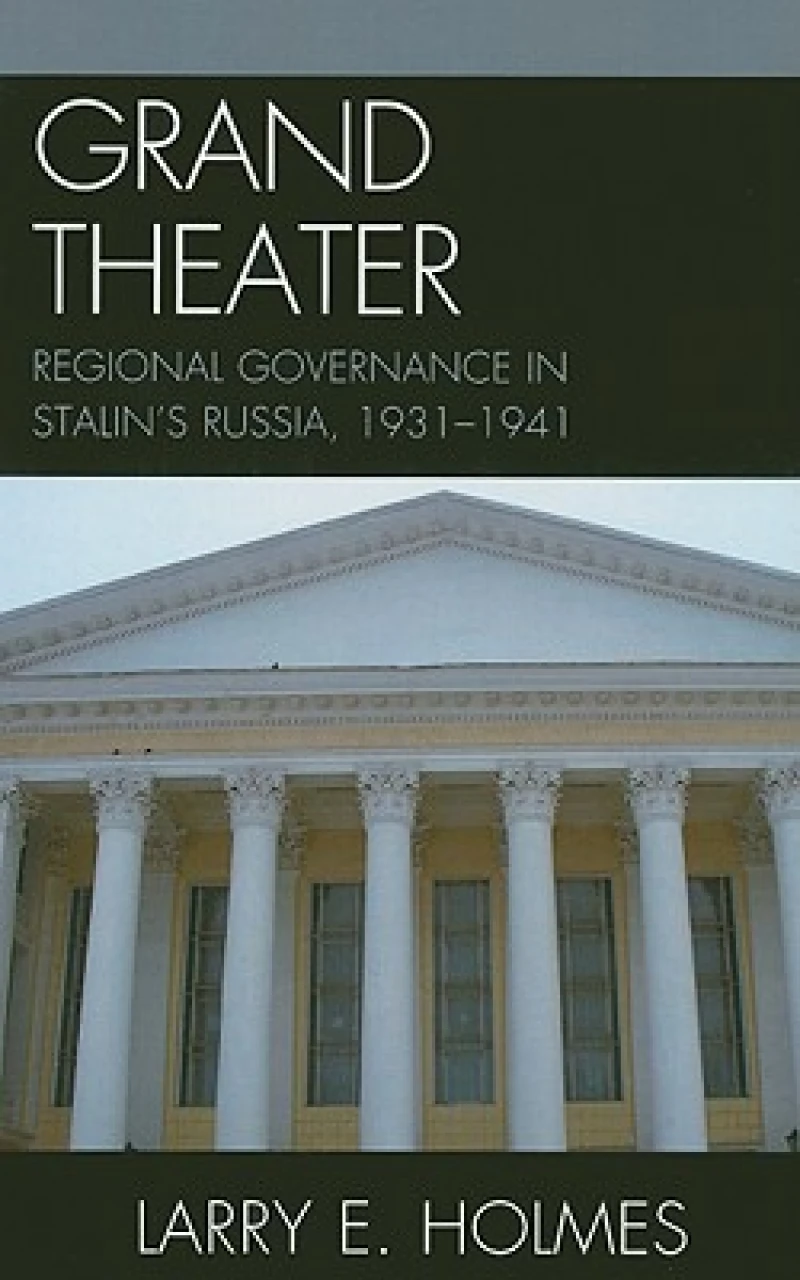
Grand Theater : Regional Governance in Stalin's Russia, 1931-1941
Book Details
Format
Hardback or Cased Book
ISBN-10
0739135910
ISBN-13
9780739135914
Publisher
Bloomsbury Publishing Plc
Imprint
Lexington Books
Country of Manufacture
GB
Country of Publication
GB
Publication Date
Aug 16th, 2009
Print length
282 Pages
Weight
540 grams
Dimensions
23.80 x 16.40 x 2.40 cms
Product Classification:
HistoryRegional government
Ksh 21,250.00
Manufactured on Demand
0 in stock
Delivery Location
Delivery fee: Select location
Secure
Quality
Fast
Grand Theater examines bureaucracy not as a readily identifiable structure but rather as a process of day-to-day operation. Thus it is concerned with how agencies of both the communist party and the state apparatus not only implemented directives from above but also responded to perceived successes and failures, chose to produce, share, and conceal information, and reacted when common citizens injected themselves into governance by making demands and complaints. It concentrates on the 1930s as a seminal period when Stalin's regime established a hypercentralized system that dominated the Soviet Union until its collapse and the Russian Federation since then. It also focuses on the administration of schools as the primary window through which to examine governance because of the importance of education to Soviet authorities, most notably Stalin himself, and the accessibility of archival documents in this field, one not classified as particularly sensitive. Grand Theater provides novel insights into the functioning of Stalinist bureaucracy, brings to the forefront a new understanding of center-periphery relations, and reveals the important role of individuals in what has heretofore been largely regarded, when beyond the Kremlin's inner circle, as a highly impersonal system. It also examines in unprecedented ways the reciprocal relationship between ideology and policy formation, on the one hand, and actual administrative practices, on the other, a relationship that more often than not had negative and dysfunctional consequences for both the governed and governing. Holmes argues that the Soviet administrative system during the 1930s was much like grand theater. The documents produced for and by that system were the script for a discursive theatrical reality that inspired neither a careful appraisal of problems nor a dispassionate search for workable solutions.
Grand Theater examines bureaucracy not as a readily identifiable structure but rather as a process of day-to-day operation. Thus it is concerned with how agencies of both the communist party and the state apparatus not only implemented directives from above but also responded to perceived successes and failures, chose to produce, share, and conceal information, and reacted when common citizens injected themselves into governance by making demands and complaints. It concentrates on the 1930s as a seminal period when Stalin''s regime established a hypercentralized system that dominated the Soviet Union until its collapse and the Russian Federation since then. It also focuses on the administration of schools as the primary window through which to examine governance because of the importance of education to Soviet authorities, most notably Stalin himself, and the accessibility of archival documents in this field, one not classified as particularly sensitive. Grand Theater provides novel insights into the functioning of Stalinist bureaucracy, brings to the forefront a new understanding of center-periphery relations, and reveals the important role of individuals in what has heretofore been largely regarded, when beyond the Kremlin''s inner circle, as a highly impersonal system. It also examines in unprecedented ways the reciprocal relationship between ideology and policy formation, on the one hand, and actual administrative practices, on the other, a relationship that more often than not had negative and dysfunctional consequences for both the governed and governing. Holmes argues that the Soviet administrative system during the 1930s was much like grand theater. The documents produced for and by that system were the script for a discursive theatrical reality that inspired neither a careful appraisal of problems nor a dispassionate search for workable solutions.
Get Grand Theater by at the best price and quality guaranteed only at Werezi Africa's largest book ecommerce store. The book was published by Bloomsbury Publishing Plc and it has pages.

