
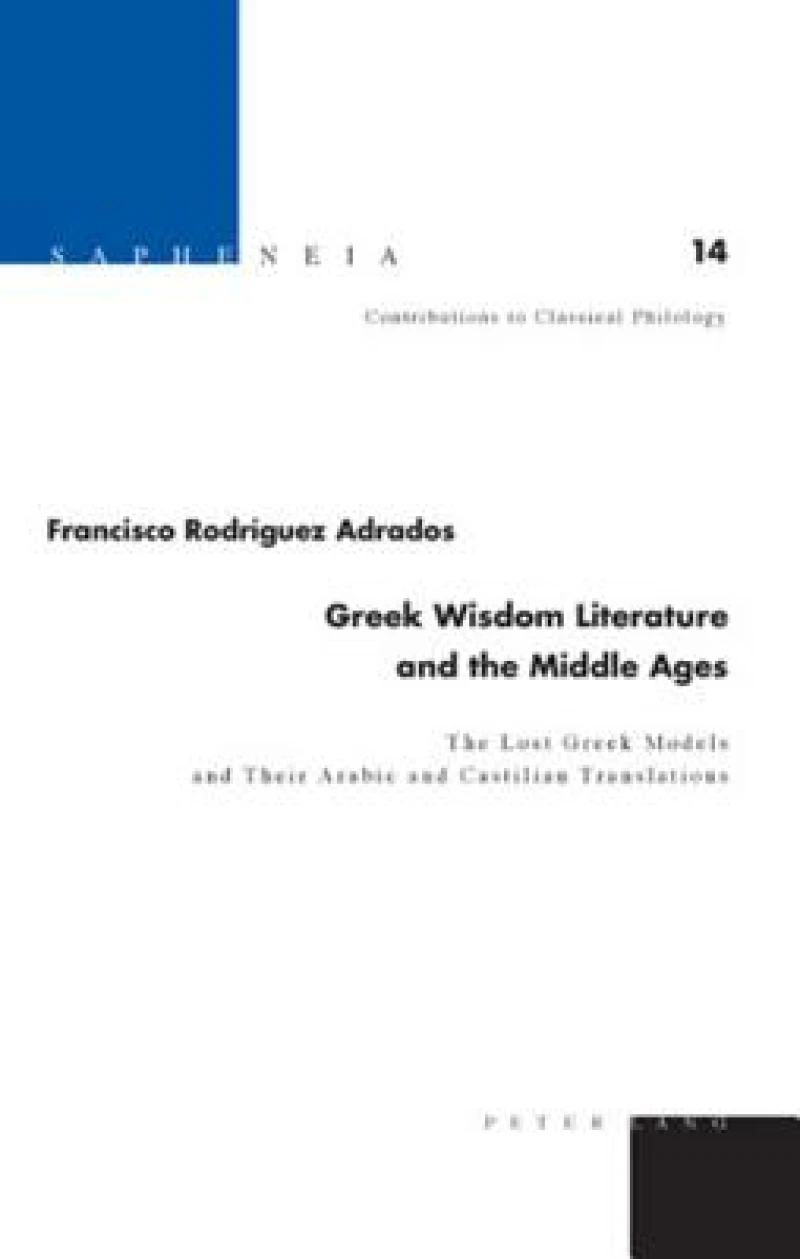
Greek Wisdom Literature and the Middle Ages : The Lost Greek Models and Their Arabic and Castilian Translations - Translated from Spanish by Joyce Greer
New
Book Details
Format
Hardback or Cased Book
Book Series
Sapheneia
ISBN-10
3039117521
ISBN-13
9783039117529
Edition
New
Publisher
Verlag Peter Lang
Imprint
Verlag Peter Lang
Country of Manufacture
CH
Country of Publication
GB
Publication Date
Jan 29th, 2009
Print length
396 Pages
Weight
622 grams
Dimensions
15.40 x 25.90 x 2.60 cms
Product Classification:
Language: reference & generalClassical textsLiterary studies: classical, early & medieval
Ksh 18,450.00
Manufactured on Demand
0 in stock
Delivery Location
Delivery fee: Select location
Secure
Quality
Fast
In 13th-century Toledo, King Alfonso the Wise fostered the publication of Castilian translations of certain Arabic works that had in turn been translated from Greek and Pehlvi. In this book, which is the revised English version of the Spanish original published under the title of Modelos griegos de la sabiduría castellana y europea, the author studies four of these Castilian translations – the Libro de los Buenos Proverbios, Poridad de las Poridades or Secreto de secretos, Bocados de Oro and Historia de la Donzella Teodor – works of sapiential literature that had an enormous influence in all of Europe. Their Arabic models had been translated from Greek in Bagdad at the instigation of the great caliphs of the 9th century and also in the Fatamid court at Cairo in the 11th century. The traditional view is that this literature is simply of oriental origin, but the author believes that the models were Greek Byzantine works discovered by the Arabs in Syria and Egypt in the 7th and 8th centuries. Their true origin is to be found in the Greek sapiential literature that developed around the figures of Socrates, Plato, Aristotle and Alexander in the Hellenistic, Roman and Byzantine schools of philosophy; its influence can frequently be found reflected in authors of Christian literature. A detailed study of themes, vocabulary and expressions in the works themselves confirms these origins.
In 13th-century Toledo, King Alfonso the Wise fostered the publication of Castilian translations of certain Arabic works that had in turn been translated from Greek and Pehlvi. In this book, which is the revised English version of the Spanish original published under the title of Modelos griegos de la sabiduria castellana y europea, the author studies four of these Castilian translations - the Libro de los Buenos Proverbios, Poridad de las Poridades or Secreto de secretos, Bocados de Oro and Historia de la Donzella Teodor - works of sapiential literature that had an enormous influence in all of Europe. Their Arabic models had been translated from Greek in Bagdad at the instigation of the great caliphs of the 9th century and also in the Fatamid court at Cairo in the 11th century. The traditional view is that this literature is simply of oriental origin, but the author believes that the models were Greek Byzantine works discovered by the Arabs in Syria and Egypt in the 7th and 8th centuries. Their true origin is to be found in the Greek sapiential literature that developed around the figures of Socrates, Plato, Aristotle and Alexander in the Hellenistic, Roman and Byzantine schools of philosophy; its influence can frequently be found reflected in authors of Christian literature. A detailed study of themes, vocabulary and expressions in the works themselves confirms these origins.
In 13th-century Toledo, King Alfonso the Wise fostered the publication of Castilian translations of certain Arabic works that had in turn been translated from Greek and Pehlvi. In this book, which is the revised English version of the Spanish original published under the title of Modelos griegos de la sabiduría castellana y europea, the author studies four of these Castilian translations – the Libro de los Buenos Proverbios, Poridad de las Poridades or Secreto de secretos, Bocados de Oro and Historia de la Donzella Teodor – works of sapiential literature that had an enormous influence in all of Europe. Their Arabic models had been translated from Greek in Bagdad at the instigation of the great caliphs of the 9th century and also in the Fatamid court at Cairo in the 11th century.
The traditional view is that this literature is simply of oriental origin, but the author believes that the models were Greek Byzantine works discovered by the Arabs in Syria and Egypt in the 7th and 8th centuries. Their true origin is to be found in the Greek sapiential literature that developed around the figures of Socrates, Plato, Aristotle and Alexander in the Hellenistic, Roman and Byzantine schools of philosophy; its influence can frequently be found reflected in authors of Christian literature. A detailed study of themes, vocabulary and expressions in the works themselves confirms these origins.
The traditional view is that this literature is simply of oriental origin, but the author believes that the models were Greek Byzantine works discovered by the Arabs in Syria and Egypt in the 7th and 8th centuries. Their true origin is to be found in the Greek sapiential literature that developed around the figures of Socrates, Plato, Aristotle and Alexander in the Hellenistic, Roman and Byzantine schools of philosophy; its influence can frequently be found reflected in authors of Christian literature. A detailed study of themes, vocabulary and expressions in the works themselves confirms these origins.
Get Greek Wisdom Literature and the Middle Ages by at the best price and quality guaranteed only at Werezi Africa's largest book ecommerce store. The book was published by Verlag Peter Lang and it has pages.

