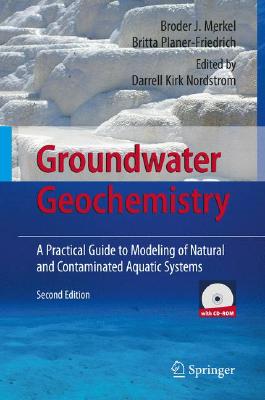
Groundwater Geochemistry : A Practical Guide to Modeling of Natural and Contaminated Aquatic Systems
Second Edition 2008
Book Details
Format
Multiple-component retail product, part(s) enclosed
ISBN-10
3540746676
ISBN-13
9783540746676
Edition
Second Edition 2008
Publisher
Springer-Verlag Berlin and Heidelberg GmbH & Co. KG
Imprint
Springer-Verlag Berlin and Heidelberg GmbH & Co. K
Country of Manufacture
GB
Country of Publication
GB
Publication Date
Jun 13th, 2008
Print length
230 Pages
Weight
552 grams
Product Classification:
Limnology (freshwater)Limnology (inland waters)
KSh 16,200.00
Currently unavailable
0 in stock
Delivery Location
Delivery fee: Select location
Secure
Quality
Fast
This second edition remains a comprehensive book on the subject. It offers beginners and advanced modelers alike a minimum theoretical background and a strong focus on the practical solution of geochemical modeling with PHREEQC.
To understand hydrochemistry and to analyze natural as well as man-made impacts on aquatic systems, hydrogeochemical models have been used since the 1960''s and more frequently in recent times. Numerical groundwater flow, transport, and geochemical models are important tools besides classical deterministic and analytical approaches. Solving complex linear or non-linear systems of equations, commonly with hundreds of unknown parameters, is a routine task for a PC. Modeling hydrogeochemical processes requires a detailed and accurate water analysis, as well as thermodynamic and kinetic data as input. Thermodynamic data, such as complex formation constants and solubility-products, are often provided as databases within the respective programs. However, the description of surface-controlled reactions (sorption, cation exchange, surface complexation) and kinetically controlled reactions requires additional input data. Unlike groundwater flow and transport models, thermodynamic models, in principal, do not need any calibration. However, considering surface-controlled or kinetically controlled reaction models might be subject to calibration. Typical problems for the application of geochemical models are: • speciation • determination of saturation indices • adjustment of equilibria/disequilibria for minerals or gases • mixing of different waters • modeling the effects of temperature • stoichiometric reactions (e.g. titration) • reactions with solids, fluids, and gaseous phases (in open and closed systems) • sorption (cation exchange, surface complexation) • inverse modeling • kinetically controlled reactions • reactive transport Hydrogeochemical models depend on the quality of the chemical analysis, the boundary conditions presumed by the program, theoretical concepts (e.g.
Get Groundwater Geochemistry by Britta Planer-Friedrich, Broder J. Merkel at the best price and quality guaranteed only at Werezi Africa's largest book ecommerce store. The book was published by Springer-Verlag Berlin and Heidelberg GmbH & Co. KG and it has 230 pages.
Customers Who Bought This Also Bought

Is a River Alive?
KSh 2,150.00

Is a River Alive?
KSh 4,500.00

Flint River User's Guide
KSh 5,200.00

Principles of Forest Hydrology
KSh 5,350.00

Saving America's Amazon
KSh 7,650.00

Altamaha
KSh 8,100.00

Ocmulgee River User's Guide
KSh 5,200.00

Searching for Home Waters
KSh 8,650.00

River of Lakes – A Journey on Florida`s St. Johns River
KSh 19,850.00
Oconee River User's Guide
KSh 6,000.00

Fields and Streams – Stream Restoration, Neoliberalism, and the Future of Environmental Science
KSh 4,650.00

Fields and Streams – Stream Restoration, Neoliberalism, and the Future of Environmental Science
KSh 12,600.00