
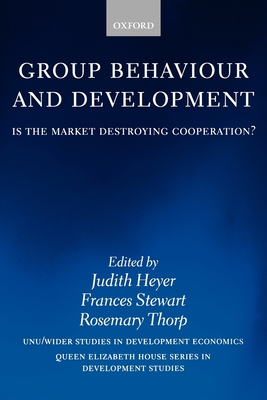
Group Behaviour and Development : Is the Market Destroying Cooperation?
Book Details
Format
Paperback / softback
Book Series
WIDER Studies in Development Economics
ISBN-10
0199256926
ISBN-13
9780199256921
Publisher
Oxford University Press
Imprint
Oxford University Press
Country of Manufacture
GB
Country of Publication
GB
Publication Date
Sep 19th, 2002
Print length
384 Pages
Weight
548 grams
Dimensions
23.50 x 15.80 x 2.10 cms
KSh 11,350.00
Temporarily out of stock, due soon
0 in stock
Delivery Location
Delivery fee: Select location
Secure
Quality
Fast
This work is an introduction to the study of group behaviour in developing countries. It provides both relevant theoretical issues and 11 case studies. The authors explore what determines modes of behaviour of groups, and the consequences for efficiency, equity, and well-being.
This book focuses on group behaviour in developing countries. It includes studies of producer and community organizations, NGOs, and some public sector groups. Despite the fact that most economic decisions are taken by people acting within groups -- families, firms, neighbourhood or community associations, and networks of producers -- the analysis of group functioning has not received enough attention, particularly among economists. Some groups function well, from the perspectives of equity, efficiency, and well-being, while others do not. This book explores why. It covers groups that perform three types of function: overcoming market failures (e.g. producer organizations); improving the position of their members (e.g. Trade Unions), and distributing resources to the less well-off (e.g. NGOs and the public sector). It contrasts three modes of group behaviour: power and control; cooperation; and the use of material incentives. It explores what determines modes of behaviour of groups, and the consequences for efficiency, equity, and well-being. The book includes eleven case studies by different authors, including producers'' associations in Brazil, farmers'' organizations in Korea and Taiwan, community forestry groups in South Asia, organizations of sex-workers in Calcutta, and health NGOs in Uganda. Claims groups tended to be the most cooperative, cooperation fostering empowerment and self-esteem. Distributive or pro bono groups mostly operated according to power and control, while market failure groups often combined all three modes.The studies show the strong impact of norms in society as a whole on group behaviour. The recent shift towards a stronger role for market incentives has exerted powerful pressures on groups to use more material incentives, undermining the cooperation essential to sustain efficiency and equity. The universal presumption in favour of monetary incentives needs to be abandoned. Non-market behaviour needs to be valued and protected as well.
Get Group Behaviour and Development by Frances Stewart at the best price and quality guaranteed only at Werezi Africa's largest book ecommerce store. The book was published by Oxford University Press and it has 384 pages.
Customers Who Bought This Also Bought

How Africa Works
KSh 3,050.00

Development as Freedom
KSh 2,900.00

How Africa Works
KSh 4,500.00

Anti-Politics Machine
KSh 3,750.00

We Are Not Able to Live in the Sky
KSh 3,400.00

Apostles of Development
KSh 5,600.00

The Bottom Billion
KSh 2,500.00

Indigenous Knowledge Inquiries
KSh 6,600.00

Why Africa is poor
KSh 2,350.00

Historical Dictionary of Aid and Development Organizations
KSh 12,050.00

Contemporary Latin American Architecture
KSh 7,900.00
The Poverty of Growth
KSh 2,900.00
