
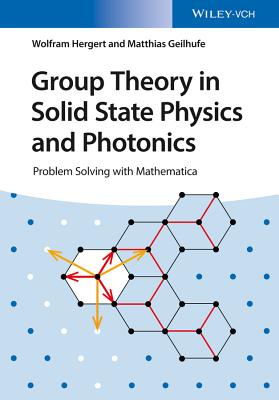
Group Theory in Solid State Physics and Photonics – Problem Solving with Mathematica : Problem Solving with Mathematica
Book Details
Format
Paperback / softback
ISBN-10
352741133X
ISBN-13
9783527411337
Publisher
Wiley-VCH Verlag GmbH
Imprint
Blackwell Verlag GmbH
Country of Manufacture
SG
Country of Publication
GB
Publication Date
Jun 20th, 2018
Print length
377 Pages
Weight
732 grams
Dimensions
17.50 x 24.90 x 2.30 cms
KSh 15,650.00
Werezi Extended Catalogue
Delivery in 12 days
2 copies in stock
Delivery Location
Delivery fee: Select location
Delivery in 12 days
Secure
Quality
Fast
While group theory is well established, this textbook raises two completely new aspects: gaining a better understanding by focusing on problem solving, making extensive use of Mathematica; offering a new tool for photonics by applying the concepts to photonic fibers and crystals.
While group theory and its application to solid state physics is well established, this textbook raises two completely new aspects. First, it provides a better understanding by focusing on problem solving and making extensive use of Mathematica tools to visualize the concepts. Second, it offers a new tool for the photonics community by transferring the concepts of group theory and its application to photonic crystals. Clearly divided into three parts, the first provides the basics of group theory. Even at this stage, the authors go beyond the widely used standard examples to show the broad field of applications. Part II is devoted to applications in condensed matter physics, i.e. the electronic structure of materials. Combining the application of the computer algebra system Mathematica with pen and paper derivations leads to a better and faster understanding. The exhaustive discussion shows that the basics of group theory can also be applied to a totally different field, as seen in Part III. Here, photonic applications are discussed in parallel to the electronic case, with the focus on photonic crystals in two and three dimensions, as well as being partially expanded to other problems in the field of photonics. The authors have developed Mathematica package GTPack which is available for download from the book's homepage. Analytic considerations, numerical calculations and visualization are carried out using the same software. While the use of the Mathematica tools are demonstrated on elementary examples, they can equally be applied to more complicated tasks resulting from the reader's own research.
Get Group Theory in Solid State Physics and Photonics – Problem Solving with Mathematica by R. Matthias Geilhufe, Wolfram Hergert at the best price and quality guaranteed only at Werezi Africa's largest book ecommerce store. The book was published by Wiley-VCH Verlag GmbH and it has 377 pages.
Customers Who Bought This Also Bought

Scripture and the Authority of God – How to read the Bible today
KSh 2,150.00

Quantum Optics
KSh 10,800.00

New Developments in Applied SUPER..(V15)
KSh 46,800.00

Introduction To Solid State Physics
KSh 12,600.00

Micro Light Emitting Diode
KSh 21,600.00

Fuel Cells I
KSh 45,000.00

Photoresponsive Polymers II
KSh 32,400.00

Condensed Matter Theories, Volume 18
KSh 35,100.00

Physics Meets Mineralogy
KSh 24,650.00

Coulomb Excitations and Decays in Graphene-Related Systems
KSh 10,150.00

Handbook of Nanophysics
KSh 16,750.00

Solid State Materials Chemistry
KSh 16,300.00
