
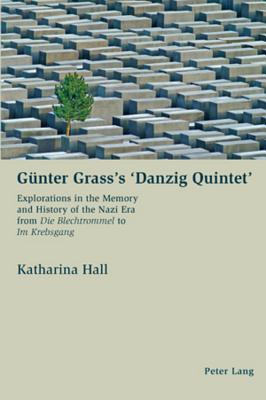
Guenter Grass’s ‘Danzig Quintet’ : Explorations in the Memory and History of the Nazi Era from Die Blechtrommel to Im Krebsgang
Book Details
Format
Paperback / softback
ISBN-10
3039109014
ISBN-13
9783039109012
Publisher
Verlag Peter Lang
Imprint
Verlag Peter Lang
Country of Manufacture
CH
Country of Publication
GB
Publication Date
Sep 5th, 2007
Print length
215 Pages
Weight
314 grams
Dimensions
15.20 x 27.50 x 1.30 cms
Product Classification:
GermanyCanadaGerman1871–1914 (German Imperial period)Early 20th century c 1900 to c 1950Literary studies: generalLiterary studies: post-colonial literatureLiterary studies: postcolonial literatureModern history to 20th century: c 1700 to c 190021st century history: from c 2000 -History
KSh 9,000.00
Currently unavailable
0 in stock
Delivery Location
Delivery fee: Select location
Secure
Quality
Fast
This study extends the long-established notion of Grass’s ‘Danzig Trilogy’ to that of the ‘Danzig Quintet’ – a literary project of epic proportions, which explores the evolution of Germany’s relationship to its Nazi past over a period of forty years.
The interlocking stories of Die Blechtrommel (1959), Katz und Maus (1961), Hundejahre (1963), örtlich betäubt (1969) and Im Krebsgang (2002) are mediated by the memory and language of seven first-person narrators. Using the dual conceptualisation of memory developed by Freud and Lacan – ‘reliving’ versus ‘recollecting’ the past – the author shows how these narrators’ accounts assert the reality of the Holocaust (as well as German wartime suffering), while highlighting the reluctance of ordinary Germans to admit their involvement in the Nazi regime.
This delineation of the complex relationship of three generations to their history is deepened by the intertextual nature of the quintet. Using the theory of Peter Brooks, Umberto Eco, Shoshana Felman and Hayden White, the study explores how Grass’s textual strategies encourage the reader to view all five works as one overarching narrative, while simultaneously avoiding any literary or historical closure. In the process, the study places each book in the context of its moment of production, and also considers the implications of Grass’s belated admission, in August 2006, that he served with the Waffen-SS during the final months of World War Two.
The interlocking stories of Die Blechtrommel (1959), Katz und Maus (1961), Hundejahre (1963), örtlich betäubt (1969) and Im Krebsgang (2002) are mediated by the memory and language of seven first-person narrators. Using the dual conceptualisation of memory developed by Freud and Lacan – ‘reliving’ versus ‘recollecting’ the past – the author shows how these narrators’ accounts assert the reality of the Holocaust (as well as German wartime suffering), while highlighting the reluctance of ordinary Germans to admit their involvement in the Nazi regime.
This delineation of the complex relationship of three generations to their history is deepened by the intertextual nature of the quintet. Using the theory of Peter Brooks, Umberto Eco, Shoshana Felman and Hayden White, the study explores how Grass’s textual strategies encourage the reader to view all five works as one overarching narrative, while simultaneously avoiding any literary or historical closure. In the process, the study places each book in the context of its moment of production, and also considers the implications of Grass’s belated admission, in August 2006, that he served with the Waffen-SS during the final months of World War Two.
Get Guenter Grass’s ‘Danzig Quintet’ by Katharina Hall at the best price and quality guaranteed only at Werezi Africa's largest book ecommerce store. The book was published by Verlag Peter Lang and it has 215 pages.
Customers Who Bought This Also Bought

How to Read a Book
KSh 2,000.00
Decolonising the Mind
KSh 4,700.00

How to Read & Why
KSh 2,350.00
Arabian Nights'' Entertainments
KSh 2,950.00
In the Wake
KSh 3,600.00
The Birth of Tragedy
KSh 1,800.00
Against Nature
KSh 1,800.00

The White Album
KSh 3,250.00
Robinson Crusoe
KSh 1,450.00
Metaphysical Poetry
KSh 2,350.00
Reading Lessons
KSh 2,350.00

Literature Book
KSh 4,250.00

