
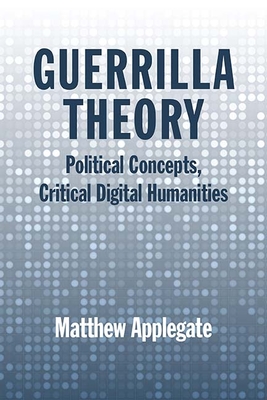
Guerrilla Theory : Political Concepts, Critical Digital Humanities
Book Details
Format
Hardback
ISBN-10
0810140853
ISBN-13
9780810140851
Publisher
Northwestern University Press
Imprint
Northwestern University Press
Country of Manufacture
US
Country of Publication
GB
Publication Date
Oct 30th, 2019
Print length
208 Pages
Weight
229 grams
Dimensions
23.10 x 15.40 x 1.70 cms
Product Classification:
Literary studies: generalTeaching skills & techniquesTeaching skills and techniques
KSh 19,600.00
Werezi Extended Catalogue
Delivery in 12 days
1 copies in stock
Delivery Location
Delivery fee: Select location
Delivery in 12 days
Secure
Quality
Fast
Examines the political, ontological, and technological underpinnings of the guerrilla in the digital humanities. Matthew Applegate uses the guerrilla to connect popular iterations of digital humanities’ practice to its political rhetoric and infrastructure. By doing so, he reorients DH’s conceptual lexicon around practices of collective becoming.
Guerrilla Theory examines the political, ontological, and technological underpinnings of the guerrilla in the digital humanities (DH). The figure of the guerrilla appears in digital humanities’ recent history as an agent of tactical reformation. It refers to a broad swath of disciplinary desires: digital humanities’ claim to collaborative and inclusive pedagogy, minimal and encrypted computing, and a host of minoritarian political interventions in its praxis, including queer politics, critical race studies, and feminist theory.
In this penetrating study, Matthew Applegate uses the guerrilla to connect popular iterations of digital humanities’ practice to its political rhetoric and infrastructure. By doing so, he reorients DH’s conceptual lexicon around practices of collective becoming, mediated by claims to conflict, antagonism, and democratic will.
The book pairs a theory-driven analysis of DH minoritarian interventions alongside contemporary political theory. It traces Michael Hardt and Antonio Negri’s radical democratic ingresses into network theory, the guerrilla’s role in its discourse, and concerns for DH’s own invocation of the figure. The book also connects post- and decolonial, feminist, and Marxist iterations of DH praxis to the aesthetic histories of actually existing guerrilla movements, such as Latin American Third Cinema, New York–based Black Mask’s antirepresentational politics, and the documentary cinema of the Black Panther Party.
Concluding with a meditation on contemporary political modalities inherent in DH’s disciplinary expansion, Guerrilla Theory offers a concept of DH as a form of critical university studies, challenging DH’s current political scope, and thus its future institutional impact.
In this penetrating study, Matthew Applegate uses the guerrilla to connect popular iterations of digital humanities’ practice to its political rhetoric and infrastructure. By doing so, he reorients DH’s conceptual lexicon around practices of collective becoming, mediated by claims to conflict, antagonism, and democratic will.
The book pairs a theory-driven analysis of DH minoritarian interventions alongside contemporary political theory. It traces Michael Hardt and Antonio Negri’s radical democratic ingresses into network theory, the guerrilla’s role in its discourse, and concerns for DH’s own invocation of the figure. The book also connects post- and decolonial, feminist, and Marxist iterations of DH praxis to the aesthetic histories of actually existing guerrilla movements, such as Latin American Third Cinema, New York–based Black Mask’s antirepresentational politics, and the documentary cinema of the Black Panther Party.
Concluding with a meditation on contemporary political modalities inherent in DH’s disciplinary expansion, Guerrilla Theory offers a concept of DH as a form of critical university studies, challenging DH’s current political scope, and thus its future institutional impact.
Get Guerrilla Theory by Matthew Applegate at the best price and quality guaranteed only at Werezi Africa's largest book ecommerce store. The book was published by Northwestern University Press and it has 208 pages.
Customers Who Bought This Also Bought

How to Read a Book
KSh 2,000.00

Decolonising the Mind
KSh 4,700.00

How to Read & Why
KSh 2,350.00

Arabian Nights'' Entertainments
KSh 2,950.00

In the Wake
KSh 3,600.00
The Birth of Tragedy
KSh 1,800.00

Against Nature
KSh 1,800.00

The White Album
KSh 3,250.00
Robinson Crusoe
KSh 1,450.00

Metaphysical Poetry
KSh 2,350.00

Reading Lessons
KSh 2,350.00

Literature Book
KSh 4,250.00
