
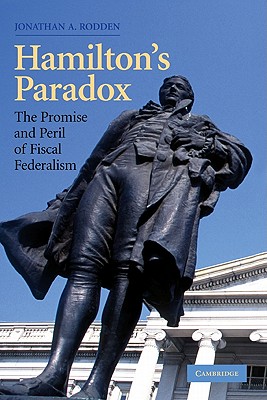
Hamilton''s Paradox : The Promise and Peril of Fiscal Federalism
Book Details
Format
Hardback
Book Series
Cambridge Studies in Comparative Politics
ISBN-10
0521842697
ISBN-13
9780521842693
Publisher
Cambridge University Press
Imprint
Cambridge University Press
Country of Manufacture
GB
Country of Publication
GB
Publication Date
Dec 26th, 2005
Print length
334 Pages
Weight
558 grams
Dimensions
23.50 x 15.70 x 2.40 cms
Product Classification:
Economic history
KSh 9,250.00
Currently unavailable
0 in stock
Delivery Location
Delivery fee: Select location
Secure
Quality
Fast
As new federations take shape and old ones are revived around the world, a difficult challenge is to create incentives for fiscal discipline. By combining theory, quantitative analysis, and contemporary case studies, this book lays out the first systematic explanation of why decentralized countries have had dramatically different fiscal experiences.
As new federations take shape and old ones are revived around the world, a difficult challenge is to create incentives for fiscal discipline. A key question is whether a politically-motivated central government can credibly commit not to bail out subnational governments in times of crisis if it funds most of their expenditures. The center can commit when subnational governments retain significant tax autonomy, as in the United States. Or if the center dominates taxation, it can tightly regulate borrowing, as in many unitary systems. In a third group of countries including Brazil and Germany, the center can neither commit to a system of market-based discipline nor gain a monopoly over borrowing. By combining theory, quantitative analysis, and historical and contemporary case studies, this book explains why different countries have had dramatically different experiences with subnational fiscal discipline.
Get Hamilton''s Paradox by Jonathan A. Rodden at the best price and quality guaranteed only at Werezi Africa's largest book ecommerce store. The book was published by Cambridge University Press and it has 334 pages.
Customers Who Bought This Also Bought

Basic Laws of Human Stupidity
KSh 2,000.00

Economics Book
KSh 4,250.00

The Great Escape
KSh 2,900.00

Abundance
KSh 2,150.00

General Theory of Employment, Interest and Money
KSh 1,400.00

Guns, Germs and Steel
KSh 2,400.00

What Happened to Liberal Democracy?
KSh 3,050.00

Abundance
KSh 3,050.00

Autocracy, Inc
KSh 2,350.00

Autocracy, Inc
KSh 3,600.00

Capital in the Twenty–First Century
KSh 4,350.00
A Culture of Growth – The Origins of the Modern Economy
KSh 3,950.00