
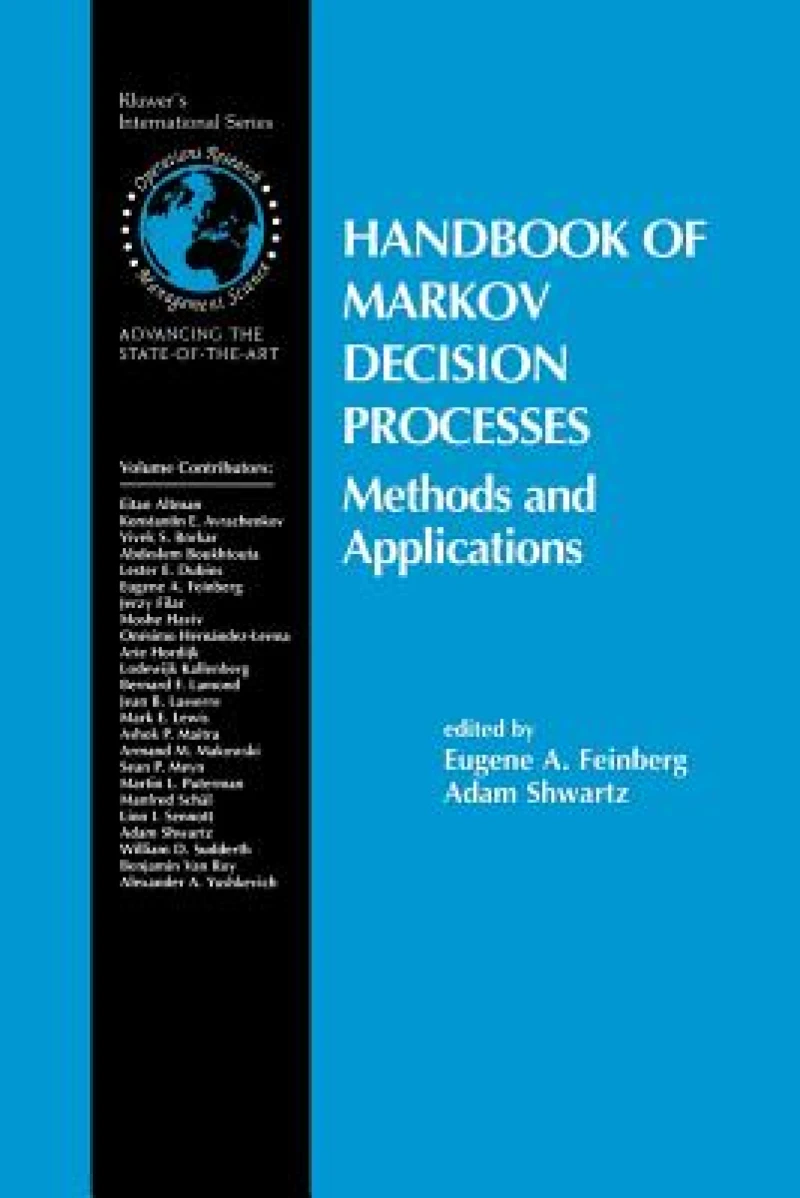
Handbook of Markov Decision Processes : Methods and Applications
Softcover reprint of the original 1st ed. 2002
Book Details
Format
Paperback / Softback
ISBN-10
1461352487
ISBN-13
9781461352488
Edition
Softcover reprint of the original 1st ed. 2002
Publisher
Springer-Verlag New York Inc.
Imprint
Springer-Verlag New York Inc.
Country of Manufacture
US
Country of Publication
GB
Publication Date
Oct 29th, 2012
Print length
565 Pages
Ksh 59,950.00
Werezi Extended Catalogue
0 in stock
Delivery Location
Delivery fee: Select location
Secure
Quality
Fast
1.1 AN OVERVIEW OF MARKOV DECISION PROCESSES The theory of Markov Decision Processes-also known under several other names including sequential stochastic optimization, discrete-time stochastic control, and stochastic dynamic programming-studiessequential optimization ofdiscrete time stochastic systems.
Eugene A. Feinberg Adam Shwartz This volume deals with the theory of Markov Decision Processes (MDPs) and their applications. Each chapter was written by a leading expert in the re spective area. The papers cover major research areas and methodologies, and discuss open questions and future research directions. The papers can be read independently, with the basic notation and concepts ofSection 1.2. Most chap ters should be accessible by graduate or advanced undergraduate students in fields of operations research, electrical engineering, and computer science. 1.1 AN OVERVIEW OF MARKOV DECISION PROCESSES The theory of Markov Decision Processes-also known under several other names including sequential stochastic optimization, discrete-time stochastic control, and stochastic dynamic programming-studiessequential optimization ofdiscrete time stochastic systems. The basic object is a discrete-time stochas tic system whose transition mechanism can be controlled over time. Each control policy defines the stochastic process and values of objective functions associated with this process. The goal is to select a "good" control policy. In real life, decisions that humans and computers make on all levels usually have two types ofimpacts: (i) they cost orsavetime, money, or other resources, or they bring revenues, as well as (ii) they have an impact on the future, by influencing the dynamics. In many situations, decisions with the largest immediate profit may not be good in view offuture events. MDPs model this paradigm and provide results on the structure and existence of good policies and on methods for their calculation.
Get Handbook of Markov Decision Processes by at the best price and quality guaranteed only at Werezi Africa's largest book ecommerce store. The book was published by Springer-Verlag New York Inc. and it has pages.

