
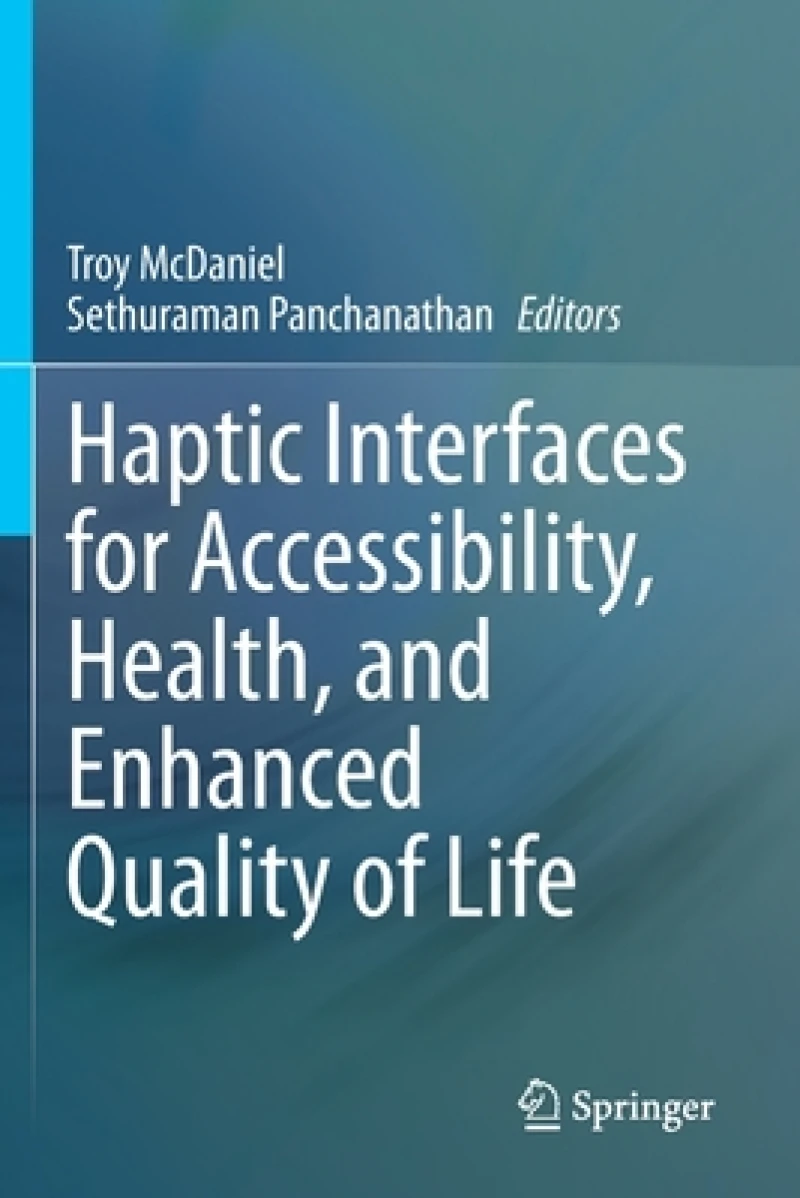
Haptic Interfaces for Accessibility, Health, and Enhanced Quality of Life
2020 ed.
Book Details
Format
Paperback / Softback
ISBN-10
3030342328
ISBN-13
9783030342326
Edition
2020 ed.
Publisher
Springer Nature Switzerland AG
Imprint
Springer Nature Switzerland AG
Country of Manufacture
GB
Country of Publication
GB
Publication Date
Dec 19th, 2020
Print length
297 Pages
Ksh 14,400.00
Werezi Extended Catalogue
0 in stock
Delivery Location
Delivery fee: Select location
Secure
Quality
Fast
This book is the first resource to provide in-depth coverage on topical areas of assistive, rehabilitative, and health-related applications for haptic (touch-based) technologies. Application topics are grouped into thematic areas spanning haptic devices for sensory impairments, health and well-being, and physical impairments which are illustrated in this book. A diverse group of experts in the field were invited to contribute different chapters to provide complementary and multidisciplinary perspectives. Unlike other books on haptics, which focus on human haptic perception, specific modalities of haptics (e.g., realistic haptic rendering), or broadly cover the subfields of haptics, this book takes an application-oriented approach to present a tour of how the field of haptics has been advanced with respect to important, impactful thematic focuses. Under Theme 1 “Sensory Impairments”, haptics technologies to support individuals with sensory impairments is presented which includes: Spatial awareness in sensory impairments through touch; Haptically-assisted interfaces for persons with visual impairments; and Enabling learning experiences for visually impaired children by interaction design. Under Theme 2 “Haptics for Health and Well-Being”, haptics technologies aimed at supporting exercise and healthy aging will be covered including: Haptics in rehabilitation, exergames and health; Therapeutic haptics for mental health and well-being; and Applications of haptics in medicine. Under Theme 3 “Haptics for Physical Impairments”, haptics technologies for enhancing the quality of life for individuals with weakened/impaired limbs or neurological diseases impacting movement is targeted including: Assistive soft exoskeletons with pneumatic artificial muscles; Haptics for accessibility in rehabilitative hardware; and intelligent robotics and immersive displays for enhancing haptic interaction in physical rehabilitation environments. Engineers, scientists, and researchers working in the areas of haptics, multimedia, virtual/augmented/mixed-reality, human-computer interaction, assistive technologies, rehabilitative technologies, healthcare technologies, and/or actuator design will want to purchase this book. Advanced level students and hobbyists interested in haptics will also be interested in this book.
This book is the first resource to provide in-depth coverage on topical areas of assistive, rehabilitative, and health-related applications for haptic (touch-based) technologies. Application topics are grouped into thematic areas spanning haptic devices for sensory impairments, health and well-being, and physical impairments which are illustrated in this book. A diverse group of experts in the field were invited to contribute different chapters to provide complementary and multidisciplinary perspectives. Unlike other books on haptics, which focus on human haptic perception, specific modalities of haptics (e.g., realistic haptic rendering), or broadly cover the subfields of haptics, this book takes an application-oriented approach to present a tour of how the field of haptics has been advanced with respect to important, impactful thematic focuses.
Under Theme 1 "Sensory Impairments", haptics technologies to support individuals with sensory impairments is presented which includes: Spatial awareness in sensory impairments through touch; Haptically-assisted interfaces for persons with visual impairments; and Enabling learning experiences for visually impaired children by interaction design. Under Theme 2 "Haptics for Health and Well-Being", haptics technologies aimed at supporting exercise and healthy aging will be covered including: Haptics in rehabilitation, exergames and health; Therapeutic haptics for mental health and well-being; and Applications of haptics in medicine. Under Theme 3 "Haptics for Physical Impairments", haptics technologies for enhancing the quality of life for individuals with weakened/impaired limbs or neurological diseases impacting movement is targeted including: Assistive soft exoskeletons with pneumatic artificial muscles; Haptics for accessibility in rehabilitative hardware; and intelligent robotics and immersive displays for enhancing haptic interaction in physical rehabilitation environments.
Engineers, scientists, and researchers working in the areas of haptics, multimedia, virtual/augmented/mixed-reality, human-computer interaction, assistive technologies, rehabilitative technologies, healthcare technologies, and/or actuator design will want to purchase this book. Advanced level students and hobbyists interested in haptics will also be interested in this book.
Get Haptic Interfaces for Accessibility, Health, and Enhanced Quality of Life by at the best price and quality guaranteed only at Werezi Africa's largest book ecommerce store. The book was published by Springer Nature Switzerland AG and it has pages.

