
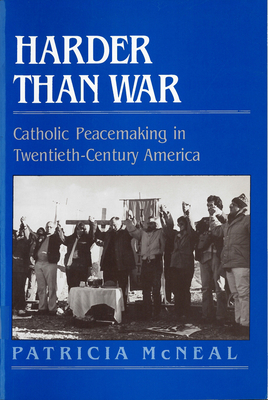
Harder Than War : Catholic Peacemaking in Twentieth-Century America
Book Details
Format
Paperback / softback
ISBN-10
0813517400
ISBN-13
9780813517407
Publisher
Rutgers University Press
Imprint
Rutgers University Press
Country of Manufacture
US
Country of Publication
GB
Publication Date
Feb 1st, 1992
Print length
344 Pages
Weight
450 grams
Dimensions
22.70 x 15.40 x 2.10 cms
KSh 4,850.00
Temporarily out of stock, due soon
0 in stock
Delivery Location
Delivery fee: Select location
Secure
Quality
Fast
Patricia McNeal''s comprehensive study of American Catholic peacemaking in the twentieth century documents the growth of pacifism and nonviolence within the American Catholic community, and assesses its impact on the church and the nation.
During the Viet Nam War, Catholic Workers burned their draft cards and turned from nonviolence to resistance by practicing civil disobedience. Daniel and Philip Berrigan escalated that resistance when they destroyed draft files, and symbolically poured blood over and hammered nuclear weapons to awaken the national conscience to the life-ending effects of nuclear warfare.
McNeal begins with the first official Catholic peace organization in the United States, the Catholic Association for International Peace, founded in 1927. An elitist lay organization supported by the church hierarchy, the CAIP based their opposition to war on the "just war" doctrine. With the emergence of pacifism among American Catholics in 1930s, Dorothy Day, co-founder of the Catholic Peace movement, added to the Catholic theological agenda the concepts of pacifism, conscientious objection, and nuclear pacifism. Dorothy Day and the Catholic Worker movement became the midwife in the formation of other Catholic peace organizations such as PAX, the Catholic Peace Fellowship, and PAX Christi-USA during the Vietnam War. Members of these groups cooperated with the broader peace movement in the United States. Their main focus became opposition to nuclear warfare and nuclear weapons.
During the Viet Nam War, Catholic Workers burned their draft cards and turned from nonviolence to resistance by practicing civil disobedience. Daniel and Philip Berrigan escalated that resistance when they destroyed draft files, and symbolically poured blood over and hammered nuclear weapons to awaken the national conscience to the life-ending effects of nuclear warfare.
McNeal concludes that Catholic peacemakers had the greatest impact not on the government but on the institutional church. In 1971 the American hierarchy judged that the Vietnam War was not a "just war." For the first time in the United States, and possibly in history, a national hierarchy announced as unjust a war being waged by its own nation.
Get Harder Than War by Patricia F. McNeal at the best price and quality guaranteed only at Werezi Africa's largest book ecommerce store. The book was published by Rutgers University Press and it has 344 pages.
Customers Who Bought This Also Bought
Letters to My Palestinian Neighbor
KSh 3,400.00

Leadership
KSh 2,700.00
Voices for Peace
KSh 2,000.00

What You Have Heard Is True
KSh 2,350.00

To Perpetual Peace
KSh 2,000.00
Thich Nhat Hanh 2026 Wall Calendar
KSh 2,150.00
Israel’s Palestinians
KSh 4,700.00

Routledge Handbook on China-Middle East Relations
KSh 9,250.00

The One State Reality
KSh 6,000.00
Coming Storm
KSh 3,950.00

How to Spot a Fascist
KSh 1,100.00
Israel’s Palestinians
KSh 8,800.00
