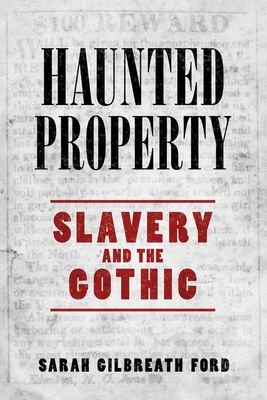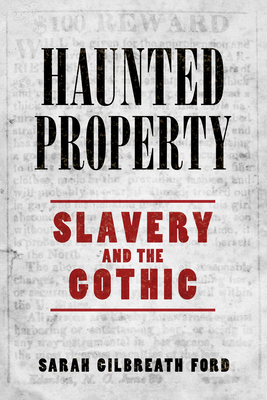
Haunted Property : Slavery and the Gothic
Book Details
Format
Paperback / softback
ISBN-10
1496829700
ISBN-13
9781496829702
Publisher
University Press of Mississippi
Imprint
University Press of Mississippi
Country of Manufacture
US
Country of Publication
GB
Publication Date
Aug 25th, 2020
Print length
248 Pages
Weight
386 grams
Dimensions
15.20 x 22.90 x 1.90 cms
KSh 4,850.00
Currently unavailable
0 in stock
Delivery Location
Delivery fee: Select location
Secure
Quality
Fast
While property ownership is a cornerstone of the American dream, the status of enslaved people supplies a contrasting American nightmare. Sarah Gilbreath Ford considers how writers in works from nineteenth-century slave narratives to twenty-first-century poetry employ gothic tools to portray the horrors of this nightmare.
At the heart of America's slave system was the legal definition of people as property. While property ownership is a cornerstone of the American dream, the status of enslaved people supplies a contrasting American nightmare. Sarah Gilbreath Ford considers how writers in works from nineteenth-century slave narratives to twenty-first-century poetry employ gothic tools, such as ghosts and haunted houses, to portray the horrors of this nightmare. Haunted Property: Slavery and the Gothic thus reimagines the southern gothic, which has too often been simply equated with the macabre or grotesque and then dismissed as regional.
Although literary critics have argued that the American gothic is driven by the nation's history of racial injustice, what is missing in this critical conversation is the key role of property. Ford argues that out of all of slavery's perils, the definition of people as property is the central impetus for haunting because it allows the perpetration of all other terrors. Property becomes the engine for the white accumulation of wealth and power fueled by the destruction of black personhood.
Specters often linger, however, to claim title, and Ford argues that haunting can be a bid for property ownership. Through examining works by Harriet Jacobs, Hannah Crafts, Mark Twain, Herman Melville, Sherley Anne Williams, William Faulkner, Eudora Welty, Toni Morrison, Octavia Butler, and Natasha Trethewey, Ford reveals how writers can use the gothic to combat legal possession with spectral possession.
Although literary critics have argued that the American gothic is driven by the nation's history of racial injustice, what is missing in this critical conversation is the key role of property. Ford argues that out of all of slavery's perils, the definition of people as property is the central impetus for haunting because it allows the perpetration of all other terrors. Property becomes the engine for the white accumulation of wealth and power fueled by the destruction of black personhood.
Specters often linger, however, to claim title, and Ford argues that haunting can be a bid for property ownership. Through examining works by Harriet Jacobs, Hannah Crafts, Mark Twain, Herman Melville, Sherley Anne Williams, William Faulkner, Eudora Welty, Toni Morrison, Octavia Butler, and Natasha Trethewey, Ford reveals how writers can use the gothic to combat legal possession with spectral possession.
Get Haunted Property by Sarah Gilbreath Ford at the best price and quality guaranteed only at Werezi Africa's largest book ecommerce store. The book was published by University Press of Mississippi and it has 248 pages.
Customers Who Bought This Also Bought

How to Read a Book
KSh 2,000.00

Decolonising the Mind
KSh 4,700.00

How to Read & Why
KSh 2,350.00

Arabian Nights'' Entertainments
KSh 2,950.00

In the Wake
KSh 3,600.00
The Birth of Tragedy
KSh 1,800.00
Against Nature
KSh 1,800.00

The White Album
KSh 3,250.00
Robinson Crusoe
KSh 1,450.00
Metaphysical Poetry
KSh 2,350.00
Reading Lessons
KSh 2,350.00

Literature Book
KSh 4,250.00