
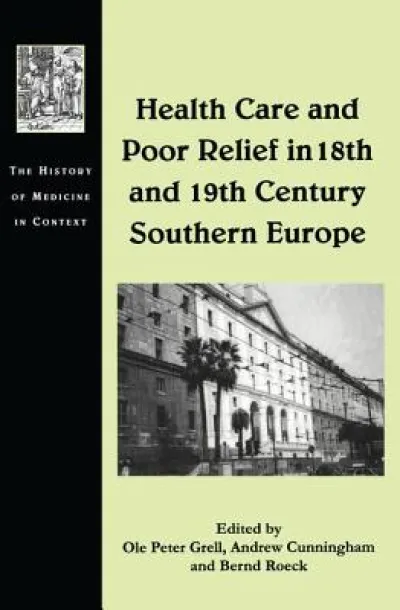
Health Care and Poor Relief in 18th and 19th Century Southern Europe
Book Details
Format
Hardback or Cased Book
Book Series
The History of Medicine in Context
ISBN-10
0754651568
ISBN-13
9780754651567
Publisher
Taylor & Francis Ltd
Imprint
Routledge
Country of Manufacture
GB
Country of Publication
GB
Publication Date
Jun 22nd, 2005
Print length
334 Pages
Weight
780 grams
Ksh 30,950.00
Werezi Extended Catalogue
0 in stock
Delivery Location
Delivery fee: Select location
Secure
Quality
Fast
In this volume, various aspects of Southern European health care and poor relief are examined. Issues of charity and medicine are discussed both in their national and wider European context. By studying the crucial transitional period between the parish relief of the late medieval world and the state sponsored provision of the twentieth century much can be learned about how attitudes to the poor and sick changed over time and place.
The poor and the sick-poor have always presented a problem to the governments and churches of Europe. Whose responsibility are they? Are they a wilful burden on the honest working population, or are they a necessary presence for the true Christian to live the true Christian life? In the 18th and 19th centuries what happened to the poor and the sick-poor in the north and south of Europe was different. In the north there occurred first the Reformation in the 16th century, which changed attitudes to the poor, and then the advent of industrialisation, with its far-reaching effects of pauperisation of people both in town and countryside. In the Catholic south, where industrialisation did not appear so soon, the Catholic Church introduced a programme of reform at all levels but along traditional lines. This included the founding of new orders dedicated to the care of the poor and sick, of new institutions within which to house and care for them. At all times it was taken for granted that it was a necessary aspect of being a Christian that one should give for the care of the needy, and that this was not the duty of the state or of secular institutions. The secularising movement did however reach the southern countries by way both of the Enlightenment and - more drastically - in the form of the Napoleonic invasions. But after the defeat of Napoleon, the Church reasserted its right to administer and control the support of the poor and sick, and this situation continued until 1900 in most areas. Moreover the effects of industrialisation and the concomitant increase in population did make itself felt in the south in the course of the 19th century, which put great stress on the institutions for poor relief and health care for the poor. All this is still relevant today, since the situations that governments and the Catholic Church found themselves confronted with, and the stark choices they had to make, are being replayed to some extent today. Who is responsible for the poor, who is to blame for their being poor? How should their poverty be relieved, how should the health care of the many be funded? These are still live issues today. While complete in itself the present volume also forms the fourth and last of a four-volume survey of health care and poor relief in Europe between 1500 and 1900, edited by Ole Peter Grell and Andrew Cunningham
Get Health Care and Poor Relief in 18th and 19th Century Southern Europe by at the best price and quality guaranteed only at Werezi Africa's largest book ecommerce store. The book was published by Taylor & Francis Ltd and it has pages.

