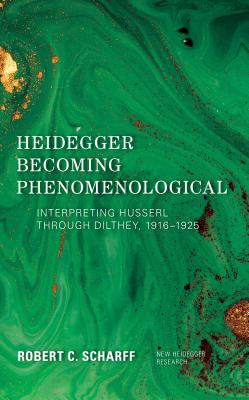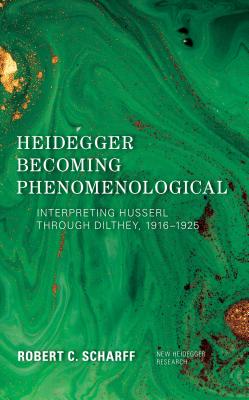
Heidegger Becoming Phenomenological : Interpreting Husserl through Dilthey, 1916–1925
Book Details
Format
Hardback
Book Series
New Heidegger Research
ISBN-10
1786607727
ISBN-13
9781786607720
Publisher
Bloomsbury Publishing PLC
Imprint
Rowman & Littlefield International
Country of Manufacture
US
Country of Publication
GB
Publication Date
Dec 14th, 2018
Print length
214 Pages
Weight
472 grams
Dimensions
16.00 x 23.50 x 2.20 cms
KSh 23,000.00
Currently unavailable
0 in stock
Delivery Location
Delivery fee: Select location
Secure
Quality
Fast
This book sets the record straight about the greater influence of Dilthey than Husserl in Heidegger’s initial formulation of his conception of phenomenology.
In this first book-length study of the topic, Robert C. Scharff offers a detailed analysis of the young Heidegger’s interpretation of Dilthey’s hermeneutics of historical life and Husserl’s transcendental phenomenology. He argues that it is Heidegger’s prior reading of Dilthey that grounds his critical appropriation of Husserl’s phenomenology. He shows that in Heidegger’s early lecture courses, a “possible” phenomenology is presented as a genuine alternative with the modern philosophies of consciousness to which Husserl’s “actual” phenomenology is still too closely tied. All of these philosophies tend to overestimate the degree to which we can achieve intellectual independence from our surroundings and inheritance. In response, Heidegger explains why becoming phenomenological is always a possibility; but being a phenomenologist is not. Scharff concludes that this discussion of the young Heidegger, Husserl, and Dilthey leads to the question of our own current need for a phenomenological philosophy—that is, for a philosophy that avoids technique-happiness, that at least sometimes thinks with a self-awareness that takes no theoretical distance from life, and that speaks in a language that is “not yet” selectively representational.
Get Heidegger Becoming Phenomenological by Robert C. Scharff at the best price and quality guaranteed only at Werezi Africa's largest book ecommerce store. The book was published by Bloomsbury Publishing PLC and it has 214 pages.
Customers Who Bought This Also Bought

Recognising the Stranger
KSh 1,800.00

The Origin of Language
KSh 4,500.00
Sharing Thoughts
KSh 17,000.00

An Inquiry Into Meaning and Truth
KSh 3,750.00

Semiotics and the Philosophy of Language
KSh 3,400.00

An Introduction to Logic
KSh 6,650.00

Walker Percy''s Search for Community
KSh 5,950.00

Film Figures
KSh 16,450.00

The Tacit Dimensions of Language and Logic
KSh 15,800.00

Metaphors in Action
KSh 21,600.00
Frontiers in Semiotics
KSh 3,000.00

A Theory of Death
KSh 11,900.00