
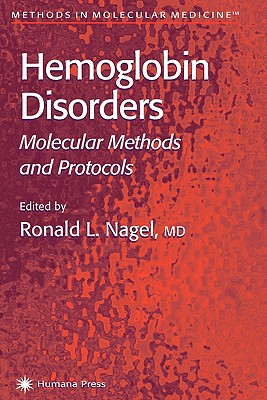
Hemoglobin Disorders : Molecular Methods and Protocols
1st ed. Softcover of orig. ed. 2003
Book Details
Format
Paperback / softback
Book Series
Methods in Molecular Medicine
ISBN-10
1617372781
ISBN-13
9781617372780
Edition
1st ed. Softcover of orig. ed. 2003
Publisher
Humana Press Inc.
Imprint
Humana Press Inc.
Country of Manufacture
GB
Country of Publication
GB
Publication Date
Nov 9th, 2010
Print length
300 Pages
Product Classification:
Haematology
KSh 22,950.00
Currently unavailable
0 in stock
Delivery Location
Delivery fee: Select location
Secure
Quality
Fast
Hemoglobin and Hemoglobinologists This volume, Hemoglobin Disorders: Molecular Methods and Protocols, will be introduced with a review of the great milestones in the field, and the scientists responsible for those achievements.
Hemoglobin and Hemoglobinologists This volume, Hemoglobin Disorders: Molecular Methods and Protocols, will be introduced with a review of the great milestones in the field, and the scientists responsible for those achievements. The history of hemoglobin can be divided into three periods: the Classical period, the Modern period, and the Post-Modern period. I am inclined to include as the four major members of the classical period Francis Roughton, Quentin Gibson, Jeffries Wyman, and Linus Pauling, not only because of their achievements, but also because of the superb scientists they trained and/or influenced. Francis John Worsely Roughton (1899-1972) (Fig. 1), in his laboratory at Trinity College in Cambridge, England, made the first measurements of the rapid reaction of oxygen with hemoglobin at the millisecond scale, at first by flow-mixing methods and later by flash photolysis. He not only opened an era of molecular research of hemoglobin, but also invented the methodology for fast reactions through the use of laser technology, which was later improved by others so that even faster reactions could be detected. Another contribution of Roughton was the education of Quentin H. Gibson (Fig. 2), his favorite s- dent, who, in his laboratory in Sheffield, continued to expand the horizon of ligand binding to hemoglobin, defining the oxygen binding constants for each of the hemes of hemoglobin. Though this did not, as expected, solve the und- lying mechanism of ligand cooperativity as discussed below, it was nonet- less an important milestone.
Get Hemoglobin Disorders by Ronald L. Nagel at the best price and quality guaranteed only at Werezi Africa's largest book ecommerce store. The book was published by Humana Press Inc. and it has 300 pages.
Customers Who Bought This Also Bought

Antibody Therapy
KSh 18,000.00

Threshold Decision-making in Clinical Medicine
KSh 10,800.00

Clinical Hematology and Fundamentals of Hemostasis
KSh 25,900.00

Life?s Blood
KSh 8,100.00

Diagnostik- und Therapieschemata hämatologischer Erkrankungen
KSh 22,250.00

Oxford Handbook of Clinical and Laboratory Investigation
KSh 7,400.00

Haploidentical Stem Cell Transplantation
KSh 16,200.00

Hematology in Practice
KSh 17,100.00

Haematology
KSh 5,950.00
Regenerative Therapy Using Blood-Derived Stem Cells
KSh 23,400.00

ECAT Assay Procedures
KSh 12,950.00
Serum/Plasma Proteomics
KSh 22,950.00
More in This Genre
Antibody Therapy
KSh 18,000.00
Threshold Decision-making in Clinical Medicine
KSh 10,800.00
Clinical Hematology and Fundamentals of Hemostasis
KSh 25,900.00
Life?s Blood
KSh 8,100.00
Diagnostik- und Therapieschemata hämatologischer Erkrankungen
KSh 22,250.00
Oxford Handbook of Clinical and Laboratory Investigation
KSh 7,400.00
