
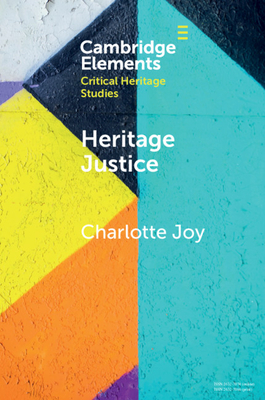
Heritage Justice
Book Details
Format
Paperback / softback
Book Series
Elements in Critical Heritage Studies
ISBN-10
1108820522
ISBN-13
9781108820523
Publisher
Cambridge University Press
Imprint
Cambridge University Press
Country of Manufacture
GB
Country of Publication
GB
Publication Date
Nov 19th, 2020
Print length
66 Pages
Weight
110 grams
Dimensions
15.10 x 22.70 x 0.70 cms
Product Classification:
Museology and heritage studiesMuseology & heritage studiesArchaeologyArchaeology
KSh 3,250.00
Currently unavailable
0 in stock
Delivery Location
Delivery fee: Select location
Secure
Quality
Fast
This Element explores how far past wrongs can be remedied through compensatory mechanisms involving material culture. It goes beyond a critique of global heritage brokers such as UNESCO, the ICC and museums as redundant, Eurocentric and elitist to explore why these institutions have become the focus for debates about global heritage justice.
Heritage Justice explores how far past wrongs can be remedied through compensatory mechanisms involving material culture. The Element goes beyond a critique of global heritage brokers such as UNESCO, the ICC and museums as redundant, Eurocentric and elitist to explore why these institutions have become the focus for debates about global heritage justice. Three broad modes of compensatory mechanisms are identified: recognition, economic reparation and return. Arguing against Jenkins (2016) that museums should not be the site for difficult conversations about the past, Heritage Justice proposes that it is exactly the space around objects and sites created by museums and global institutions that allows for conversations about future dignity. The challenge for cultural practitioners is to broaden out ideas of material identity beyond source communities, private property and economic value to encompass dynamic global shifts in mobility and connectivity.
Get Heritage Justice by Charlotte Joy at the best price and quality guaranteed only at Werezi Africa's largest book ecommerce store. The book was published by Cambridge University Press and it has 66 pages.
Customers Who Bought This Also Bought

To the Sea by Train
KSh 3,400.00

The Artist as Curator
KSh 6,650.00

Theorising the Artist Interview
KSh 30,950.00
Remembering Enslavement
KSh 7,900.00

Cleaning
KSh 30,950.00

Conservation of Natural History Specimens
KSh 46,800.00
Elusive Archives
KSh 15,500.00

Intangible Cultural Heritage Law and the Digital Era
KSh 30,950.00
Remembering Enslavement
KSh 26,700.00

Cleaning
KSh 7,200.00

Fragmented Illuminations
KSh 9,000.00

Fragmented Illuminations
KSh 5,400.00
