
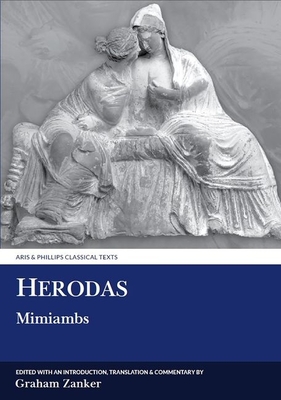
Herodas: Mimiambs
Book Details
Format
Paperback / softback
Book Series
Aris & Phillips Classical Texts
ISBN-10
0856688738
ISBN-13
9780856688737
Publisher
Liverpool University Press
Imprint
Aris & Phillips Ltd
Country of Manufacture
GB
Country of Publication
GB
Publication Date
Aug 1st, 2009
Print length
240 Pages
Weight
350 grams
Dimensions
21.10 x 16.30 x 2.10 cms
KSh 6,400.00
Currently unavailable
0 in stock
Delivery Location
Delivery fee: Select location
Secure
Quality
Fast
Before the publication of the second-century AD papyrus containing eight and a fragmentary ninth of the Mimiambs of Herodas in 1891, Herodas was known only through approximately twenty lines which had survived in quotations found principally in Athenaios and Stobaios.
Before the publication of the second-century AD papyrus containing eight and a fragmentary ninth of the Mimiambs of Herodas in 1891, Herodas was known only through approximately twenty lines which had survived in quotations found principally in Athenaios and Stobaios. Even after the publication of the papyrus and subsequent work on it, scarcely anything is known of their author. The scant evidence that has survived suggests that he lived in during the reign of Ptolemy Philadelphos (285-247 BC), on the island of Kos, and was a direct contemporary of the greatest of the Hellenistic poets, Callimachus, Theocritus and Apollonius. His Mimiambs are short humorous dramatic scenes written in verse, often bawdy, reflecting everyday life and dialect. In this Aris & Phillips Classical Text , Graham Zanker explores what we do know of the poet including the language, dialect and metre that he uses. Each poem is translated and accompanied by an individual commentary with synopsis, information on date, setting, sources and purpose, as well as close examination of vocabulary and grammar. This edition reveals Herodas' work in all its skill and subtlety.
Get Herodas: Mimiambs by Graham Zanker at the best price and quality guaranteed only at Werezi Africa's largest book ecommerce store. The book was published by Liverpool University Press and it has 240 pages.
Customers Who Bought This Also Bought

Perfect Nine
KSh 2,350.00

Collected Poems of Samuel Beckett
KSh 4,500.00
Milk and Honey
KSh 2,350.00
The Divine Comedy
KSh 2,150.00

And Still I Rise
KSh 2,000.00
Paradise Lost
KSh 1,600.00
Forest of Noise
KSh 1,800.00
The Odyssey
KSh 1,800.00
The Odyssey
KSh 1,600.00

The Iliad
KSh 1,450.00
Citizen
KSh 2,350.00
Paradise Lost
KSh 2,000.00
