
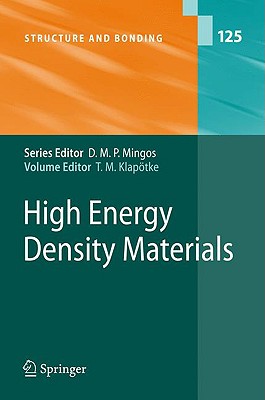
High Energy Density Materials
Book Details
Format
Hardback
Book Series
Structure and Bonding
ISBN-10
3540722017
ISBN-13
9783540722014
Publisher
Springer-Verlag Berlin and Heidelberg GmbH & Co. KG
Imprint
Springer-Verlag Berlin and Heidelberg GmbH & Co. K
Country of Manufacture
GB
Country of Publication
GB
Publication Date
Jul 11th, 2007
Print length
286 Pages
KSh 32,400.00
Currently unavailable
0 in stock
Delivery Location
Delivery fee: Select location
Secure
Quality
Fast
This book summarizes some recent developments in the area of high-energy high-density (HEDM) materials. Rather than being comprehensive in scope, emphasis is given to structural and bonding features of highly energetic - terials with possible applications as high explosives (secondary explosives) or propellants. In this book we do not focus on primary explosives (e.g. lead azidereplacements)sincebyde?nitiontheexplosiveperformance(detonation velocity and detonation pressure) of such materials - although very sensitive -are much less energetic than secondary (high) explosives. Modern HEDMs derive most of their energy (i) from oxidation of the c- bon backbone, as in traditional energetic materials, (ii) from ring or cage strain, or (iii) from their very high positive heat of formation. Examples of the?rstclassare traditionalexplosives, suchasTNT,RDXand HMX.Modern nitro-compounds, such as CL-20 or the recently reported hepta- and octa- trocubanes, belong to the second group of explosives and possess very high densities and enhance the energies utilizing substantial cage strain. Members of the third class of compounds are high-nitrogen compounds (up to 85% - trogencontent), such as aminotetrazole and nitrotetrazolederivatives, which show the desired remarkable insensitivity to electrostatic discharge, friction and impact, while having very high positive heats of formation and therefore very high explosive powers. The synthesis of energetic, non-nuclear materials for military application has been a long-term goal in various academic and military research groups worldwide. Some of the current challenges that face HEDMscientists are: • Demandforenvironmentallycompatibleandtoxicologicallyacceptable- plosives and propellants. Examples are replacements for TNT, RDX and HMXsince nitro-explosivesper se,aswellastheir environmental transf- mation products, are toxic.
Get High Energy Density Materials by Thomas M. Klapötke at the best price and quality guaranteed only at Werezi Africa's largest book ecommerce store. The book was published by Springer-Verlag Berlin and Heidelberg GmbH & Co. KG and it has 286 pages.
Customers Who Bought This Also Bought

Boron
KSh 4,500.00

Fluorine In Pharmaceutical And Medicinal Chemistry: From Biophysical Aspects To Clinical Applications
KSh 32,400.00

Magnetic Ceramics
KSh 26,450.00

Ultra-High Temperature Materials III
KSh 45,000.00
Nuclear Chemistry
KSh 12,600.00

Solid-State Electrochemistry
KSh 13,500.00

Advances in Organic Crystal Chemistry
KSh 23,400.00

Reactive and Functional Polymers Volume Three
KSh 32,400.00
Handbook of Fibers and Polymers
KSh 23,750.00

Bone-Grafting Biomaterials
KSh 17,650.00

Templates in Chemistry I
KSh 32,400.00

Supramolecular Assembly via Hydrogen Bonds I
KSh 32,400.00
