
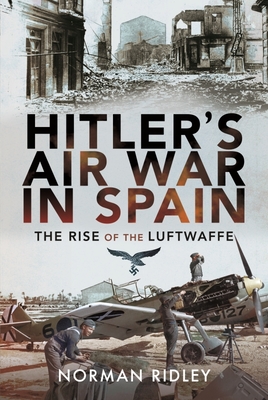
Hitler's Air War in Spain : The Rise of the Luftwaffe
Book Details
Format
Hardback
ISBN-10
1399084720
ISBN-13
9781399084727
Publisher
Pen & Sword Books Ltd
Imprint
Air World
Country of Manufacture
GB
Country of Publication
GB
Publication Date
May 6th, 2022
Print length
256 Pages
Weight
510 grams
Dimensions
16.40 x 24.10 x 2.80 cms
Product Classification:
Second World WarAir forces and warfareAir forces & warfareSecond World War
KSh 4,500.00
Werezi Extended Catalogue
Delivery in 12 days
2 copies in stock
Delivery Location
Delivery fee: Select location
Delivery in 12 days
Secure
Quality
Fast
Explains the background to the conflict in Spain and the international reaction to the outbreak of the fighting.
Almost since the advent of warfare, civilians have suffered collateral damage', but the concept of Total War - a war without limits - only surfaced in the early part of the twentieth century. The idea of huge numbers of aircraft raining death upon defenceless cities was seen by many as not only barbaric but, in practical terms, quite unrealistic given the logistical challenges that would have to be overcome in order to put them into practice. Any complacency over the threat, however, was rudely shattered on 26 February 1935, when Adolf Hitler officially signed a decree authorizing the formation of the Luftwaffe. The third branch of Germany's armed forces erupted on to the European military landscape. Its blustering claims of irrepressible air power sent waves of panic rippling through ministries of war throughout the world. Framing a realistic response to Hitler's propaganda offensive proved to be problematic given the lack of detailed knowledge of not only the numbers, but also the true performance capabilities of his new generation of aircraft and the ways in which they had expanded the boundaries of war. It was, therefore, of huge interest to all modern military establishments when these machines were deployed during the Spanish Civil War which broke out in July 1936. Notwithstanding the limited scope of this conflict, it offered, for the participating nations, a testing ground for new machines and, for the interested observers, a window into the future of aerial warfare. When the Spanish Civil War was less than a year old it had already seen air power employed in most of the ways that it would be used in the Second World War. This not only included airlifting troops, reconnaissance, interdiction, close support and strategic bombing, but also the deliberate targeting of civilians as a means of achieving military objectives. This book looks at all the significant aerial engagements of the war and examines them against the background of the wider global context. In this way, the Spanish Civil War's part in the evolution of air power is confirmed, as is the way in which its lessons were learned, or ignored, in the context of the much greater conflagration that was to come.
Get Hitler's Air War in Spain by Norman Ridley at the best price and quality guaranteed only at Werezi Africa's largest book ecommerce store. The book was published by Pen & Sword Books Ltd and it has 256 pages.
Customers Who Bought This Also Bought

Churchill
KSh 3,700.00

Bomber Mafia
KSh 2,350.00

American Prometheus
KSh 2,700.00

Man''s Search For Meaning
KSh 1,600.00

India After Gandhi
KSh 4,850.00

Hiroshima
KSh 2,000.00

Holocaust
KSh 2,700.00

East West Street
KSh 2,350.00

Path of Light
KSh 2,350.00

Come to This Court and Cry
KSh 2,000.00

Hiroshima Men
KSh 4,500.00

Unbroken
KSh 2,350.00
More by Norman Ridley

General George Washington – Spymaster Agent 711
KSh 4,500.00

Stalin’s Top Spies
KSh 3,950.00

Secret War Between Hitler and Stalin
KSh 4,500.00

Reinhard Gehlen: Hitler’s Spymaster
KSh 4,500.00

Hitler''s U.S. Allies
KSh 3,600.00

Venlo Sting
KSh 5,400.00

The Race for the Atomic Bomb
KSh 4,500.00

The Road to Barbarossa
KSh 4,500.00

Spying for Hitler
KSh 4,500.00

Hitler and Poland
KSh 4,500.00

Hitler''s British Nazis
KSh 3,950.00

Nazi Propaganda Through Art and Architecture
KSh 3,950.00