
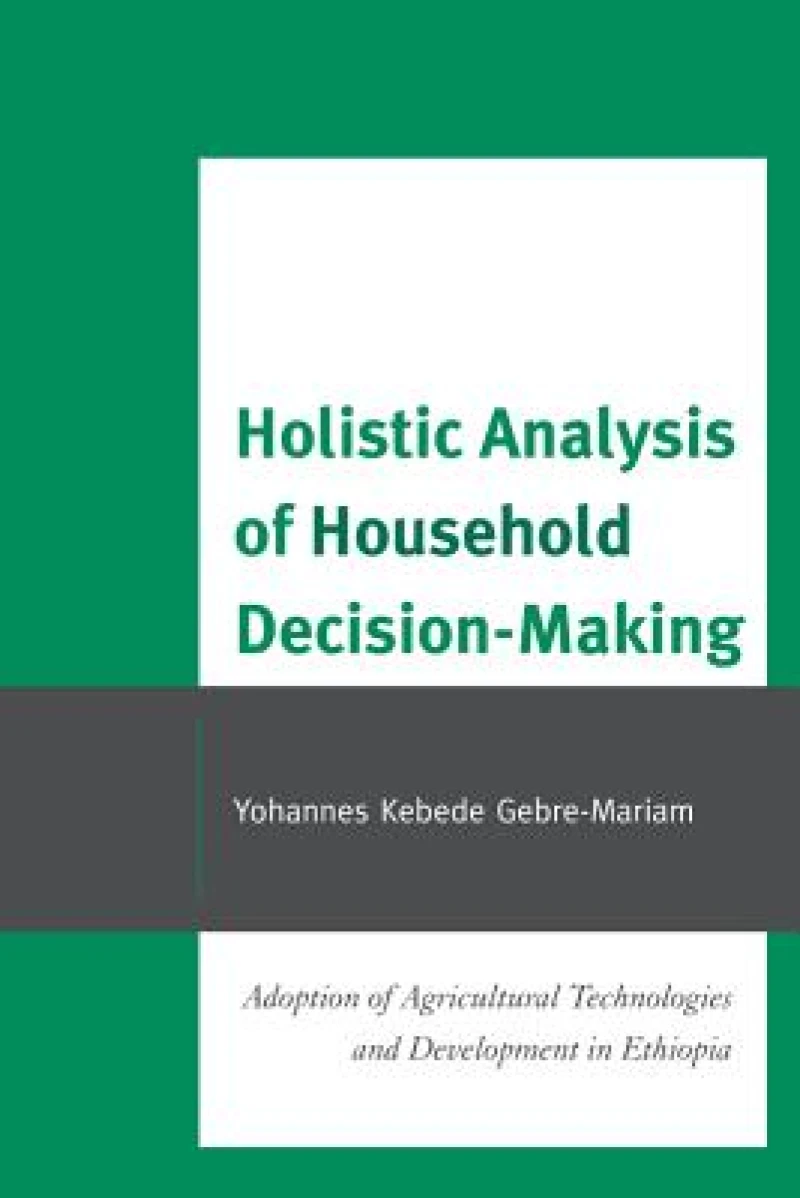
Holistic Analysis of Household Decision-Making : Adoption of Agricultural Technologies and Development in Ethiopia
Book Details
Format
Paperback / Softback
ISBN-10
0761856412
ISBN-13
9780761856412
Publisher
University Press of America
Imprint
University Press of America
Country of Manufacture
GB
Country of Publication
GB
Publication Date
Dec 12th, 2011
Print length
362 Pages
Weight
540 grams
Dimensions
23.20 x 15.50 x 2.50 cms
Ksh 9,350.00
Manufactured on Demand
0 in stock
Delivery Location
Delivery fee: Select location
Secure
Quality
Fast
The processes and consequences of household decision-making are investigated using multi-disciplinary research methods of decision analysis that involves statistical, mathematical, psychological, anthropological, and econometric techniques brought together in a holistic manner. This study is focused in the Ada and Selale regions of the Central Ethiopian Highlands. The technologies studied are fertilizer, improved crop varieties, pesticides, and cross-bred cows. Goals and strategies of households, institutions, access to information, indigenous knowledge, risk taking behavior, and their impacts on household decision-making were studied. Technology adoption was studied under a variety of controllable (e.g., allocation of labor) and uncontrollable (natural factors such as rainfall or government intervention) environments. The findings demonstrated that agricultural producers can attain greater increases in food production and the efficiency with which it is produced if they adopt at least two innovations. The study revealed that non-physical resources such as indigenous knowledge and institutions play a fundamental role on the ability of producers to achieve increases in food production. For development to be sustained, therefore, investments in physical resources should be matched with those in non-physical resources.
The processes and consequences of household decision-making are investigated using multi-disciplinary research methods of decision analysis that involves statistical, mathematical, psychological, anthropological, and econometric techniques brought together in a holistic manner. This study is focused in the Ada and Selale regions of the Central Ethiopian Highlands. The technologies studied are fertilizer, improved crop varieties, pesticides, and cross-bred cows. Goals and strategies of households, institutions, access to information, indigenous knowledge, risk taking behavior, and their impacts on household decision-making were studied. Technology adoption was studied under a variety of controllable (e.g., allocation of labor) and uncontrollable (natural factors such as rainfall or government intervention) environments. The findings demonstrated that agricultural producers can attain greater increases in food production and the efficiency with which it is produced if they adopt at least two innovations. The study revealed that non-physical resources such as indigenous knowledge and institutions play a fundamental role on the ability of producers to achieve increases in food production. For development to be sustained, therefore, investments in physical resources should be matched with those in non-physical resources.
Get Holistic Analysis of Household Decision-Making by at the best price and quality guaranteed only at Werezi Africa's largest book ecommerce store. The book was published by University Press of America and it has pages.

