
How Can the Human Mind Occur in the Physical Universe?
Book Details
Format
Paperback / Softback
ISBN-10
0195398955
ISBN-13
9780195398953
Publisher
Oxford University Press Inc
Imprint
Oxford University Press Inc
Country of Manufacture
GB
Country of Publication
GB
Publication Date
Aug 28th, 2009
Print length
304 Pages
Weight
472 grams
Dimensions
23.60 x 18.80 x 1.90 cms
Product Classification:
Cognitivism, cognitive theory
Ksh 7,150.00
Manufactured on Demand
0 in stock
Delivery Location
Delivery fee: Select location
Secure
Quality
Fast
The argument John Anderson gives in this book was inspired by the passage above, from the last lecture by one of the pioneers of cognitive science. Newell describes what, for him, is the pivotal question of scientific inquiry, and Anderson gives an answer that is emerging from the study of brain and behavior.
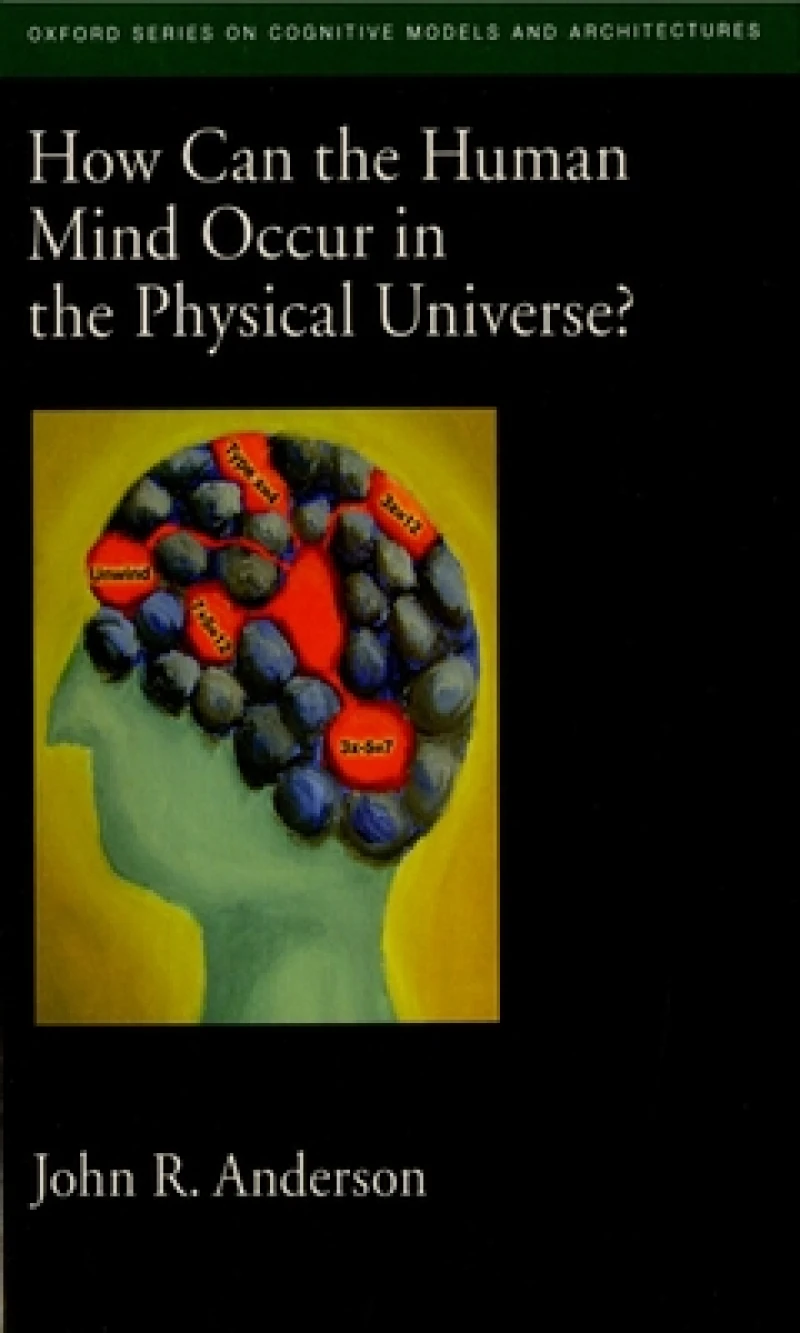
''The question for me is how can the human mind occur in the physical universe. We now know that the world is governed by physics. We now understand the way biology nestles comfortably within that. The issue is how will the mind do that as well.''--Alan Newell, December 4, 1991, Carnegie Mellon UniversityThe argument John Anderson gives in this book was inspired by the passage above, from the last lecture by one of the pioneers of cognitive science. Newell describes what, for him, is the pivotal question of scientific inquiry, and Anderson gives an answer that is emerging from the study of brain and behavior. Humans share the same basic cognitive architecture with all primates, but they have evolved abilities to exercise abstract control over cognition and process more complex relational patterns. The human cognitive architecture consists of a set of largely independent modules associated with different brain regions. In this book, Anderson discusses in detail how these various modules can combine to produce behaviors as varied as driving a car and solving an algebraic equation, but focuses principally on two of the modules: the declarative and procedural. The declarative module involves a memory system that, moment by moment, attempts to give each person the most appropriate possible window into his or her past. The procedural module involves a central system that strives to develop a set of productions that will enable the most adaptive response from any state of the modules. Newell argued that the answer to his question must take the form of a cognitive architecture, and Anderson organizes his answer around the ACT-R architecture, but broadens it by bringing in research from all areas of cognitive science, including how recent work in brain imaging maps onto the cogntive architecture.
Get How Can the Human Mind Occur in the Physical Universe? by at the best price and quality guaranteed only at Werezi Africa's largest book ecommerce store. The book was published by Oxford University Press Inc and it has pages.

