
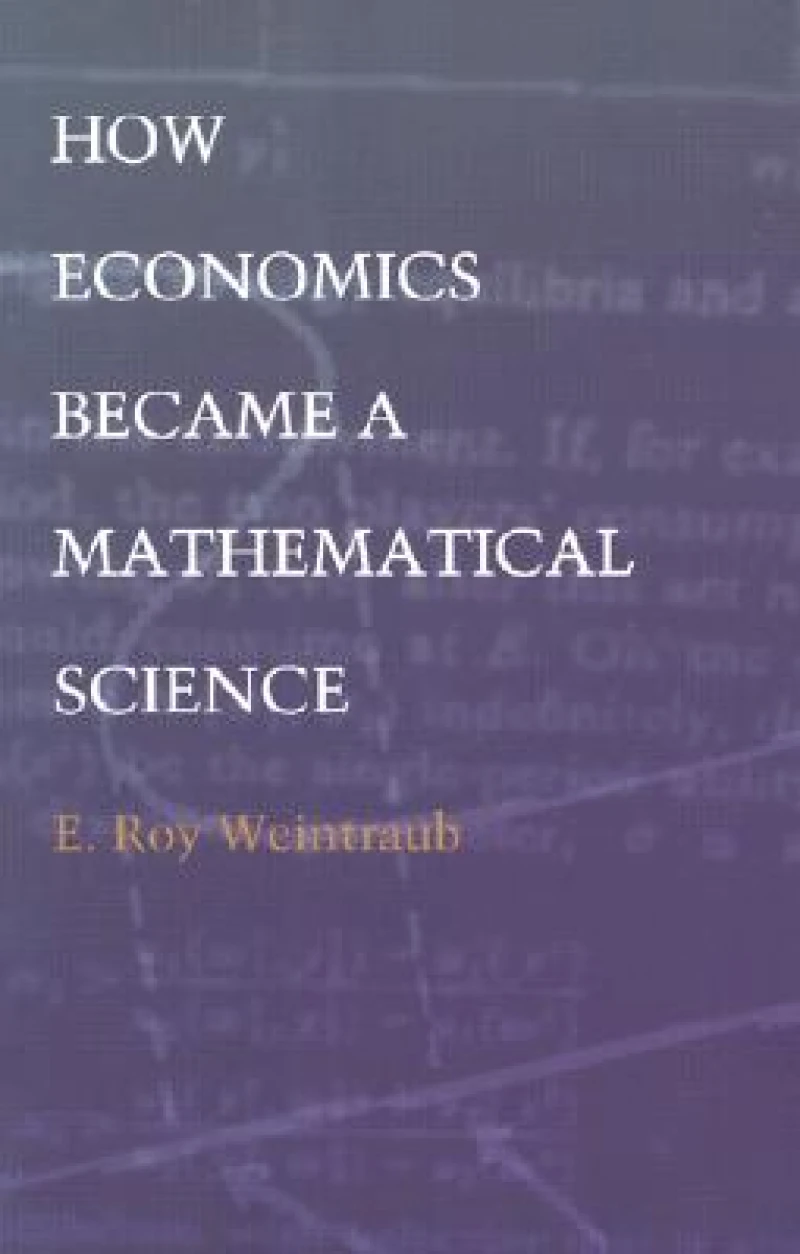
How Economics Became a Mathematical Science
Book Details
Format
Paperback / Softback
Book Series
Science and Cultural Theory
ISBN-10
0822328712
ISBN-13
9780822328711
Publisher
Duke University Press
Imprint
Duke University Press
Country of Manufacture
US
Country of Publication
GB
Publication Date
May 28th, 2002
Print length
328 Pages
Weight
510 grams
Dimensions
23.10 x 15.30 x 2.50 cms
Product Classification:
Economic theory & philosophyEconomic theory and philosophyEconomic historyMathematics
Ksh 4,850.00
Werezi Extended Catalogue
0 in stock
Delivery Location
Delivery fee: Select location
Secure
Quality
Fast
Discusses the history of 20th century economics, and how it has become dominated by mathematical approaches.
In How Economics Became a Mathematical Science E. Roy Weintraub traces the history of economics through the prism of the history of mathematics in the twentieth century. As mathematics has evolved, so has the image of mathematics, explains Weintraub, such as ideas about the standards for accepting proof, the meaning of rigor, and the nature of the mathematical enterprise itself. He also shows how economics itself has been shaped by economists’ changing images of mathematics.
Whereas others have viewed economics as autonomous, Weintraub presents a different picture, one in which changes in mathematics-both within the body of knowledge that constitutes mathematics and in how it is thought of as a discipline and as a type of knowledge-have been intertwined with the evolution of economic thought. Weintraub begins his account with Cambridge University, the intellectual birthplace of modern economics, and examines specifically Alfred Marshall and the Mathematical Tripos examinations-tests in mathematics that were required of all who wished to study economics at Cambridge. He proceeds to interrogate the idea of a rigorous mathematical economics through the connections between particular mathematical economists and mathematicians in each of the decades of the first half of the twentieth century, and thus describes how the mathematical issues of formalism and axiomatization have shaped economics. Finally, How Economics Became a Mathematical Science reconstructs the career of the economist Sidney Weintraub, whose relationship to mathematics is viewed through his relationships with his mathematician brother, Hal, and his mathematician-economist son, the book’s author.
Whereas others have viewed economics as autonomous, Weintraub presents a different picture, one in which changes in mathematics-both within the body of knowledge that constitutes mathematics and in how it is thought of as a discipline and as a type of knowledge-have been intertwined with the evolution of economic thought. Weintraub begins his account with Cambridge University, the intellectual birthplace of modern economics, and examines specifically Alfred Marshall and the Mathematical Tripos examinations-tests in mathematics that were required of all who wished to study economics at Cambridge. He proceeds to interrogate the idea of a rigorous mathematical economics through the connections between particular mathematical economists and mathematicians in each of the decades of the first half of the twentieth century, and thus describes how the mathematical issues of formalism and axiomatization have shaped economics. Finally, How Economics Became a Mathematical Science reconstructs the career of the economist Sidney Weintraub, whose relationship to mathematics is viewed through his relationships with his mathematician brother, Hal, and his mathematician-economist son, the book’s author.
Get How Economics Became a Mathematical Science by at the best price and quality guaranteed only at Werezi Africa's largest book ecommerce store. The book was published by Duke University Press and it has pages.

