
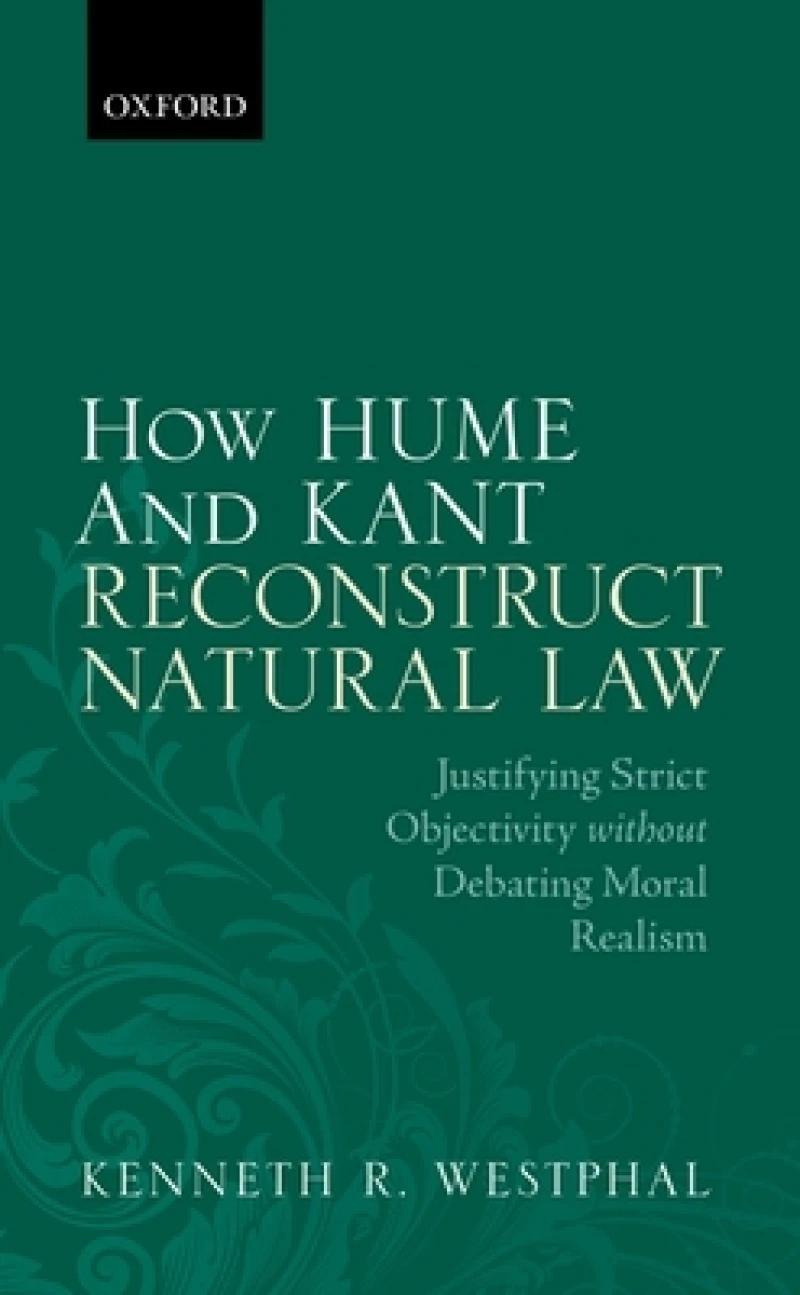
How Hume and Kant Reconstruct Natural Law : Justifying Strict Objectivity without Debating Moral Realism
Book Details
Format
Hardback or Cased Book
ISBN-10
0198747055
ISBN-13
9780198747055
Publisher
Oxford University Press
Imprint
Oxford University Press
Country of Manufacture
GB
Country of Publication
GB
Publication Date
Apr 7th, 2016
Print length
270 Pages
Weight
432 grams
Dimensions
14.60 x 32.20 x 2.20 cms
Product Classification:
Western philosophy: EnlightenmentEthics & moral philosophy
Ksh 13,250.00
Manufactured on Demand
0 in stock
Delivery Location
Delivery fee: Select location
Secure
Quality
Fast
Kenneth R. Westphal presents an original interpretation of Hume's and Kant's moral philosophies. He argues that focusing on the differences between these two accounts occludes a decisive, shared achievement: a constructivist account of the basic principles of justice which does not depend on moral realism nor moral anti-realism or irrealism.
Kenneth R. Westphal presents an original interpretation of Hume''s and Kant''s moral philosophies, the differences between which are prominent in current philosophical accounts. Westphal argues that focussing on these differences, however, occludes a decisive, shared achievement: a distinctive constructivist method to identify basic moral principles and to justify their strict objectivity, without invoking moral realism nor moral anti-realism or irrealism. Their constructivism is based on Hume''s key insight that ''though the laws of justice are artificial, they are not arbitrary''. Arbitrariness in basic moral principles is avoided by starting with fundamental problems of social coördination which concern outward behaviour and physiological needs; basic principles of justice are artificial because solving those problems does not require appeal to moral realism (nor to moral anti-realism). Instead, moral cognitivism is preserved by identifying sufficient justifying reasons, which can be addressed to all parties, for the minimum sufficient legitimate principles and institutions required to provide and protect basic forms of social coördination (including verbal behaviour). Hume first develops this kind of constructivism for basic property rights and for government. Kant greatly refines Hume''s construction of justice within his ''metaphysical principles of justice'', whilst preserving the core model of Hume''s innovative constructivism. Hume''s and Kant''s constructivism avoids the conventionalist and relativist tendencies latent if not explicit in contemporary forms of moral constructivism.
Get How Hume and Kant Reconstruct Natural Law by at the best price and quality guaranteed only at Werezi Africa's largest book ecommerce store. The book was published by Oxford University Press and it has pages.

