
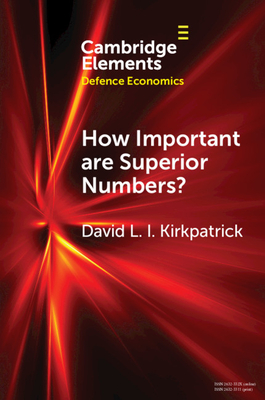
How Important are Superior Numbers? : A Reappraisal of Lanchester's Square Law
Book Details
Format
Paperback / softback
Book Series
Elements in Defence Economics
ISBN-10
1108977871
ISBN-13
9781108977876
Publisher
Cambridge University Press
Imprint
Cambridge University Press
Country of Manufacture
GB
Country of Publication
GB
Publication Date
Mar 4th, 2021
Print length
98 Pages
Weight
162 grams
Dimensions
15.10 x 23.00 x 1.00 cms
KSh 3,250.00
Currently unavailable
0 in stock
Delivery Location
Delivery fee: Select location
Secure
Quality
Fast
Frederick Lanchester formulated a model of combat suggesting the power of a military force was proportional to the product of the individual effectiveness of units in the force and the square of the number of units deployed. Analysis of battles in the American Civil War, and other contemporary wars, demonstrates the importance of superior numbers.
A century ago Frederick Lanchester formulated a mathematical model of combat which suggested that the combat power of a military force was proportional to the product of the individual effectiveness of the units in the force and the square of the number of units deployed. This model reinforced a long-established faith in the importance of superior numbers. However, successive historical studies failed to identify any clear relationship between the numbers and losses in opposing forces. This Element analyses American Civil War battles, and shows that the ratio of losses incurred was inversely proportional to the ratio of numbers effectively engaged. This result demonstrates that the numbers of fighting units in a military force are less important than the ability of those units to get into action and inflict losses on the enemy. This result demonstrates the limitations of the Square Law, and should prevent it from being applied indiscriminately.
Get How Important are Superior Numbers? by David L. I. Kirkpatrick at the best price and quality guaranteed only at Werezi Africa's largest book ecommerce store. The book was published by Cambridge University Press and it has 98 pages.
Customers Who Bought This Also Bought
Nuclear War
KSh 2,000.00

Strategy
KSh 4,350.00
The Concise 33 Strategies of War
KSh 2,000.00
The Art of War
KSh 1,100.00
The Prince
KSh 1,450.00

On War
KSh 2,000.00
Just War
KSh 8,650.00

Rearming Europe
KSh 30,950.00

Why Wars Widen
KSh 30,950.00
The South African Intelligence Services
KSh 11,150.00
Outsourcing War
KSh 7,200.00
US Democracy Promotion in the Middle East
KSh 7,550.00
