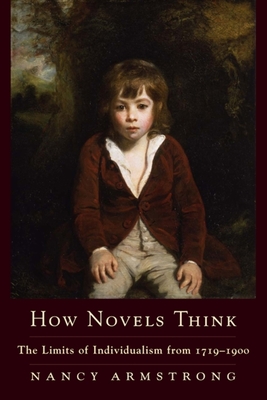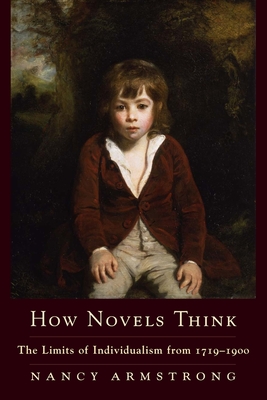
How Novels Think : The Limits of Individualism from 1719-1900
Book Details
Format
Paperback / softback
ISBN-10
0231130597
ISBN-13
9780231130592
Publisher
Columbia University Press
Imprint
Columbia University Press
Country of Manufacture
US
Country of Publication
GB
Publication Date
Jan 11th, 2006
Print length
208 Pages
Weight
338 grams
Dimensions
22.60 x 15.30 x 1.40 cms
Product Classification:
Literary studies: fiction, novelists & prose writers
KSh 5,050.00
Currently unavailable
0 in stock
Delivery Location
Delivery fee: Select location
Secure
Quality
Fast
Nancy Armstrong argues that the history of the novel and the history of the modern individual are, quite literally, one and the same. She suggests that certain works of fiction created a subject, one displaying wit, will, or energy capable of shifting the social order to grant the exceptional person a place commensurate with his or her individual worth. Once the novel had created this figure, readers understood themselves in terms of a narrative that produced a self-governing subject. In the decades following the revolutions in British North America and France, the major novelists distinguished themselves as authors by questioning the fantasy of a self-made individual. To show how novels by Defoe, Austen, Scott, Bronte, Dickens, Eliot, Hardy, Haggard, and Stoker participated in the process of making, updating, and perpetuating the figure of the individual, Armstrong puts them in dialogue with the writings of Locke, Hume, Rousseau, Malthus, Darwin, Kant, and Freud. Such theorists as Althusser, Balibar, Foucault, and Deleuze help her make the point that the individual was not one but several different figures. The delineation and potential of the modern subject depended as much upon what it had to incorporate as what alternatives it had to keep at bay to address the conflicts raging in and around the British novel.
Nancy Armstrong argues that the history of the novel and the history of the modern individual are, quite literally, one and the same. She suggests that certain works of fiction created a subject, one displaying wit, will, or energy capable of shifting the social order to grant the exceptional person a place commensurate with his or her individual worth. Once the novel had created this figure, readers understood themselves in terms of a narrative that produced a self-governing subject.
In the decades following the revolutions in British North America and France, the major novelists distinguished themselves as authors by questioning the fantasy of a self-made individual. To show how novels by Defoe, Austen, Scott, Brontë, Dickens, Eliot, Hardy, Haggard, and Stoker participated in the process of making, updating, and perpetuating the figure of the individual, Armstrong puts them in dialogue with the writings of Locke, Hume, Rousseau, Malthus, Darwin, Kant, and Freud. Such theorists as Althusser, Balibar, Foucault, and Deleuze help her make the point that the individual was not one but several different figures. The delineation and potential of the modern subject depended as much upon what it had to incorporate as what alternatives it had to keep at bay to address the conflicts raging in and around the British novel.
In the decades following the revolutions in British North America and France, the major novelists distinguished themselves as authors by questioning the fantasy of a self-made individual. To show how novels by Defoe, Austen, Scott, Brontë, Dickens, Eliot, Hardy, Haggard, and Stoker participated in the process of making, updating, and perpetuating the figure of the individual, Armstrong puts them in dialogue with the writings of Locke, Hume, Rousseau, Malthus, Darwin, Kant, and Freud. Such theorists as Althusser, Balibar, Foucault, and Deleuze help her make the point that the individual was not one but several different figures. The delineation and potential of the modern subject depended as much upon what it had to incorporate as what alternatives it had to keep at bay to address the conflicts raging in and around the British novel.
Get How Novels Think by Nancy Armstrong at the best price and quality guaranteed only at Werezi Africa's largest book ecommerce store. The book was published by Columbia University Press and it has 208 pages.
Customers Who Bought This Also Bought
Dreams in a Time of War
KSh 3,050.00
The Picture of Dorian Gray
KSh 1,250.00
Pride and Prejudice
KSh 1,150.00
Fire Next Time
KSh 1,800.00

Letters of J R R Tolkien
KSh 2,350.00
Arabian Nights'' Entertainments
KSh 2,950.00
Emma
KSh 1,350.00
The Karamazov Brothers
KSh 2,100.00
On Writing
KSh 2,000.00
Persuasion
KSh 1,100.00
Bleak House
KSh 2,150.00

To the Lighthouse
KSh 1,450.00