
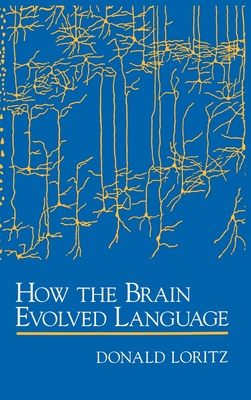
How the Brain Evolved Language
Book Details
Format
Hardback
ISBN-10
019511874X
ISBN-13
9780195118742
Publisher
Oxford University Press Inc
Imprint
Oxford University Press Inc
Country of Manufacture
GB
Country of Publication
GB
Publication Date
Nov 4th, 1999
Print length
240 Pages
Weight
522 grams
Dimensions
23.60 x 15.70 x 2.30 cms
Product Classification:
PsycholinguisticsLanguage acquisitionCognition & cognitive psychologyNeurosciences
KSh 29,850.00
Temporarily out of stock, due soon
0 in stock
Delivery Location
Delivery fee: Select location
Secure
Quality
Fast
A discussion of the history of the discovery that language is controlled by the brain, and thus somehow located in it, and the subsequent efforts of scientists in many areas to understand what language is, how the brain "contains" it, and how both language and the brain could have evolved.
Recent developments in our understanding of the way the brain works have altered dramatically our view of how it is possible for us to learn and use language - a feat that is still enormously beyond the capacity of any computer in existence or even on the drawing board. Donald Loritz describes the history of the discovery that language is controlled by the brain, and thus somehow located in it, and the subsequent efforts of scientists in many areas - linguistics, psychology, neurology, computer science, and the new field at their intersection, cognitive science - to understand what language is, how the brain "contains" it, and how both language and this complex brain could have evolved.While one can easily find computer-generated cross-sectioned pictures of the brain and its use of language, such pictures do not get down to the level of networks of individual brain cells (neurons), and how such networks are actually capable of learning and storing information like the sounds and meanings of words and the patterns of understandable sentences. Loritz explains the basic properties of the brain and neuron networks, using lay language or terms that he carefully teaches the reader, so that these mysterious processes of neural information storage and access can be understood. He does so using a mathematical model of brain function called Adaptive Resonance Theory, a theory developed by Stephen Grossberg, and applying this theory to what we know about human language - not language as grammarians conceive it, but language as it is really spoken and comprehended. He takes this information about language from recent well-documented research on child language, the signed language of the deaf, and the language of people with brain damage, as well sa from normal speakers.Loritz''s book is certain to provoke controversy, as it contradicts many of the ideas propounded by another very popular writer on brain and language, Steven Pinker. Unlike Pinker, Loritz argues that language has little if any innate component, and is something that our brains are well-equipped to learn.
Get How the Brain Evolved Language by Donald Loritz at the best price and quality guaranteed only at Werezi Africa's largest book ecommerce store. The book was published by Oxford University Press Inc and it has 240 pages.
Customers Who Bought This Also Bought

The Perks of Being a Bookworm
KSh 4,500.00
Semiotics and the Philosophy of Language
KSh 3,400.00

Chinese Children''s Reading Acquisition
KSh 16,200.00

New Trends in Language Acquisition Within the Generative Perspective
KSh 21,600.00

Vocabulary Studies in First and Second Language Acquisition
KSh 18,000.00

Improving the Emotional Intelligence of Translators
KSh 10,800.00

Phonology and Language Use
KSh 18,900.00

Engaging Children in Applied Linguistics Research
KSh 17,100.00

Optimality Theory and Pragmatics
KSh 8,100.00

Meaning
KSh 1,800.00

Nonverbal Steps to the Origins of Language
KSh 7,900.00

Active Learning from Infancy to Childhood
KSh 21,600.00
More by Donald Loritz
More in This Genre
The Perks of Being a Bookworm
KSh 4,500.00
Semiotics and the Philosophy of Language
KSh 3,400.00
Chinese Children''s Reading Acquisition
KSh 16,200.00
New Trends in Language Acquisition Within the Generative Perspective
KSh 21,600.00
Vocabulary Studies in First and Second Language Acquisition
KSh 18,000.00
Improving the Emotional Intelligence of Translators
KSh 10,800.00
