
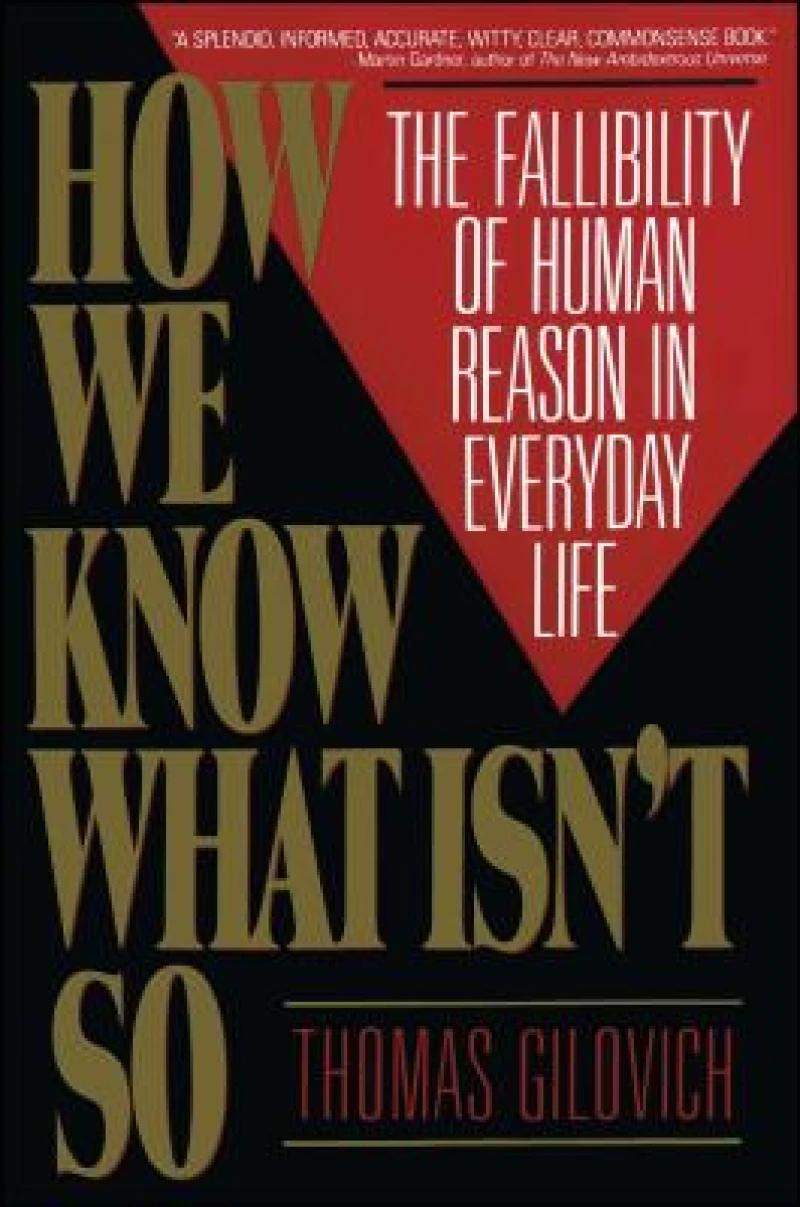
How We Know What Isn''t So
Book Details
Format
Paperback / Softback
Book Series
A Psychological Study on Logic
ISBN-10
0029117062
ISBN-13
9780029117064
Publisher
Simon & Schuster
Imprint
The Free Press
Country of Manufacture
US
Country of Publication
GB
Publication Date
Apr 26th, 1993
Print length
224 Pages
Weight
270 grams
Dimensions
23.40 x 15.50 x 1.40 cms
Ksh 2,350.00
Re-Printing
0 in stock
Delivery Location
Delivery fee: Select location
Secure
Quality
Fast
Thomas Gilovich offers a wise and readable guide to the fallacy of the obvious in everyday life.
Thomas Gilovich offers a wise and readable guide to the fallacy of the obvious in everyday life.
When can we trust what we believe—that "teams and players have winning streaks," that "flattery works," or that "the more people who agree, the more likely they are to be right"—and when are such beliefs suspect? Thomas Gilovich offers a guide to the fallacy of the obvious in everyday life. Illustrating his points with examples, and supporting them with the latest research findings, he documents the cognitive, social, and motivational processes that distort our thoughts, beliefs, judgments and decisions. In a rapidly changing world, the biases and stereotypes that help us process an overload of complex information inevitably distort what we would like to believe is reality. Awareness of our propensity to make these systematic errors, Gilovich argues, is the first step to more effective analysis and action.
When can we trust what we believe—that "teams and players have winning streaks," that "flattery works," or that "the more people who agree, the more likely they are to be right"—and when are such beliefs suspect? Thomas Gilovich offers a guide to the fallacy of the obvious in everyday life. Illustrating his points with examples, and supporting them with the latest research findings, he documents the cognitive, social, and motivational processes that distort our thoughts, beliefs, judgments and decisions. In a rapidly changing world, the biases and stereotypes that help us process an overload of complex information inevitably distort what we would like to believe is reality. Awareness of our propensity to make these systematic errors, Gilovich argues, is the first step to more effective analysis and action.
Get How We Know What Isn''t So by at the best price and quality guaranteed only at Werezi Africa's largest book ecommerce store. The book was published by Simon & Schuster and it has pages.

