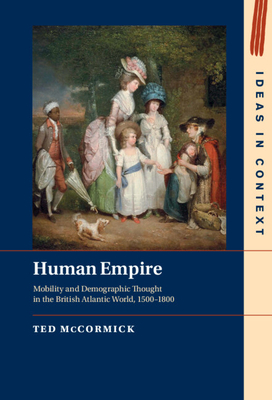
Human Empire : Mobility and Demographic Thought in the British Atlantic World, 1500–1800
Book Details
Format
Paperback / softback
Book Series
Ideas in Context
ISBN-10
1009124617
ISBN-13
9781009124614
Publisher
Cambridge University Press
Imprint
Cambridge University Press
Country of Manufacture
GB
Country of Publication
GB
Publication Date
May 23rd, 2024
Print length
312 Pages
Weight
452 grams
Dimensions
15.10 x 22.90 x 1.80 cms
Product Classification:
Political science & theoryPolitical science and theory
KSh 5,000.00
Currently unavailable
0 in stock
Delivery Location
Delivery fee: Select location
Secure
Quality
Fast
Examines the emergence of population as an object of knowledge and governance through attempts to manage poverty, vagrancy, colonization, slavery, religious difference, and empire in the early modern British Atlantic world. This engaging study connects the history of demographic ideas to early modern intellectual, political, and colonial contexts.
Arguing that demographic thought begins not with quantification but in attempts to control the qualities of people, Human Empire traces two transformations spanning the early modern period. First was the emergence of population as an object of governance through a series of engagements in sixteenth- and seventeenth-century England, Ireland, and colonial North America, influenced by humanist policy, reason of state, and natural philosophy, and culminating in the creation of political arithmetic. Second was the debate during the long eighteenth century over the locus and limits of demographic agency, as church, civil society, and private projects sought to mobilize and manipulate different marginalized and racialized groups – and as American colonists offered their own visions of imperial demography. This innovative, engaging study examines the emergence of population as an object of knowledge and governance and connects the history of demographic ideas with their early modern intellectual, political, and colonial contexts.
Get Human Empire by Ted McCormick at the best price and quality guaranteed only at Werezi Africa's largest book ecommerce store. The book was published by Cambridge University Press and it has 312 pages.
Customers Who Bought This Also Bought
Message
KSh 3,400.00
Corruptible
KSh 2,350.00

On War
KSh 1,200.00

Abundance
KSh 2,150.00
The Republic
KSh 2,350.00
What Happened to Liberal Democracy?
KSh 3,050.00
Pedagogy of the Oppressed
KSh 2,000.00

Great Ideas Social Contract
KSh 1,450.00

Fire Next Time; Nobody Knows My Name ; No Name In The Street; The Devil Finds Work
KSh 3,400.00

The Body Politic
KSh 700.00
The Prince The Original Classic
KSh 2,150.00
The Fourth Turning Is Here
KSh 2,600.00