
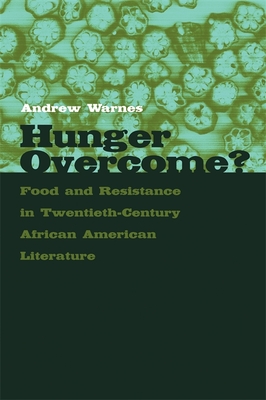
Hunger Overcome? : Food and Resistance in Twentieth-Century African American Literature
Book Details
Format
Paperback / softback
ISBN-10
0820325627
ISBN-13
9780820325620
Publisher
University of Georgia Press
Imprint
University of Georgia Press
Country of Manufacture
US
Country of Publication
GB
Publication Date
Feb 26th, 2004
Print length
232 Pages
Weight
362 grams
Dimensions
15.50 x 22.90 x 1.80 cms
KSh 7,750.00
Temporarily out of stock, due soon
0 in stock
Delivery Location
Delivery fee: Select location
Secure
Quality
Fast
This book investigates the juxtaposition of malnutrition and spectacular food abundance as a key trope of African American writing. Warnes focuses on works by Zora Neale Hurston, Richard Wright, and Toni Morrison, and considers how black characters respond to whites' attempts at regulating access to nourishment, whether physical or intellectual.
Ever since slaves in America labored to produce food surfeit while enduring personal food shortage, says Andrew Warnes, African American writers have consistently drawn connections between hunger and illiteracy, and by extension between food and reading. This book investigates the juxtaposition of malnutrition and spectacular food abundance as a key trope of African American writing. Focusing on works by Zora Neale Hurston, Richard Wright, and Toni Morrison, Warnes considers how black characters respond with a wide variety of countermaneuvers to whites' attempts at regulating access to nourishment, whether physical or intellectual. What makes this trope so powerful, Warnes argues, is that it implicitly politicizes hunger, revealing it to be an avoidable, imposed condition. In Hurston's scenes of feasting and plenty in the utopian, all-black community of Eatonville; in Wright's refusal of stale bread and spoiled molasses from his white employer; and in Morrison's depiction of her characters' strategies of pilfering and foraging, we witness the implications of a kind of hunger that could be abolished were it not useful as a means of enforcing acquiescence, dependency, and docility. Throughout Hunger Overcome? Warnes relates his readings to the wider culture by drawing on such diverse sources as the slave autobiography Narrative of the Life of Frederick Douglass, Ntozake Shange's cookbook If I Can Cook / You Know God Can, Horace Cayton and St. Clair Drake's sociological study Black Metropolis, and Stanley Kramer's film Guess Who's Coming to Dinner?
Get Hunger Overcome? by Andrew Warnes at the best price and quality guaranteed only at Werezi Africa's largest book ecommerce store. The book was published by University of Georgia Press and it has 232 pages.
Customers Who Bought This Also Bought
Dreams in a Time of War
KSh 3,050.00
Modern Classics Penguin Essays of George Orwell
KSh 2,700.00
On Writing
KSh 2,000.00

To the Lighthouse
KSh 1,450.00
On Morrison
KSh 4,500.00

Africa''s Tarnished Name
KSh 700.00
C. S. Lewis
KSh 1,800.00

Life in Letters
KSh 5,400.00

By Grand Central Station I
KSh 1,800.00
Wide Sargasso Sea
KSh 1,800.00

Mom and Me and Mom
KSh 2,000.00
Jorge Luis Borges
KSh 1,800.00
More by Andrew Warnes
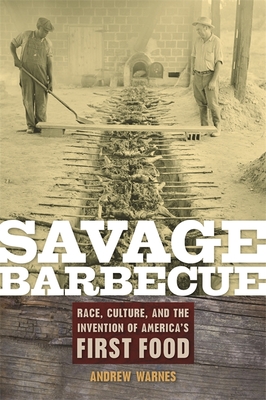
Savage Barbecue
KSh 5,000.00

American Literary Culture and the Industrial Food Revolution
KSh 4,500.00
How the Shopping Cart Explains Global Consumerism
KSh 3,800.00

Richard Wright''s Native Son
KSh 30,950.00
Richard Wright''s Native Son
KSh 8,350.00

How the Shopping Cart Explains Global Consumerism
KSh 14,400.00
