
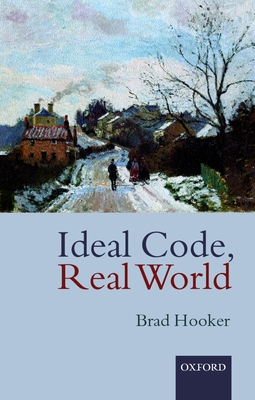
Ideal Code, Real World : A Rule-Consequentialist Theory of Morality
by
Brad Hooker
Book Details
Format
Paperback / softback
ISBN-10
0199256578
ISBN-13
9780199256570
Publisher
Oxford University Press
Imprint
Oxford University Press
Country of Manufacture
GB
Country of Publication
GB
Publication Date
Oct 3rd, 2002
Print length
230 Pages
Weight
280 grams
Dimensions
21.50 x 14.20 x 1.30 cms
Product Classification:
Ethics & moral philosophy
KSh 11,150.00
Currently unavailable
0 in stock
Delivery Location
Delivery fee: Select location
Secure
Quality
Fast
According to rule-consequentialism, acts are to be assessed in terms of rules and rules are to be assessed by their consequences. Hooker establishes criteria for assessing a theory of morality and then sets out his rule-consequentialism, discusses criticisms and rival theories and considers implications of the theory for practical issues.
What are appropriate criteria for assessing a theory of morality? In Ideal Code, Real World, Brad Hooker begins by answering this question, and then argues for a rule-consequentialist theory. According to rule-consequentialism, acts should be assessed morally in terms of impartially justified rules, and rules are impartially justified if and only if the expected overall value of their general internalization is at least as great as for any alternative rules. In the course of developing his rule-consequentialism, Hooker discusses impartiality, well-being, fairness, equality, the question of how the ''general internalization'' of rules is to be interpreted by rule-consequentialism, and the main objections to rule-consequentialism. He also discusses the social contract theory of morality, act-consequentialism, and the question of which moral prohibitions and which duties to help others rule-consequentialism endorses. The last part of the book considers the implications of rule-consequentialism for some current controversies in practical ethics.
Get Ideal Code, Real World by Brad Hooker at the best price and quality guaranteed only at Werezi Africa's largest book ecommerce store. The book was published by Oxford University Press and it has 230 pages.
Customers Who Bought This Also Bought

Xmeditations
KSh 700.00
Groundwork for the Metaphysics of Morals
KSh 2,000.00

On the Genealogy of Morals
KSh 2,000.00

Beyond Good and Evil
KSh 2,000.00
The Nicomachean Ethics
KSh 1,600.00

The Sovereignty of Good
KSh 5,400.00

Justice
KSh 2,000.00

Meditations
KSh 1,600.00
What We Owe The Future
KSh 2,000.00

The Analects
KSh 2,350.00

How to Be a Leader – An Ancient Guide to Wise Leadership
KSh 2,800.00

There Are Places in the World Where Rules Are Less Important Than Kindness
KSh 3,600.00
