
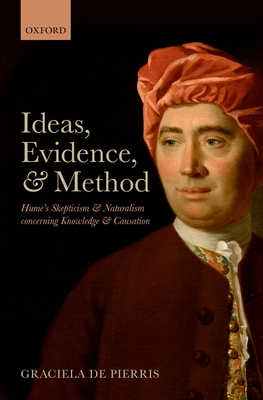
Ideas, Evidence, and Method : Hume's Skepticism and Naturalism concerning Knowledge and Causation
Book Details
Format
Hardback
ISBN-10
0198716788
ISBN-13
9780198716785
Publisher
Oxford University Press
Imprint
Oxford University Press
Country of Manufacture
GB
Country of Publication
GB
Publication Date
Apr 30th, 2015
Print length
336 Pages
Weight
644 grams
Dimensions
24.30 x 16.50 x 2.60 cms
KSh 20,050.00
Currently unavailable
0 in stock
Delivery Location
Delivery fee: Select location
Secure
Quality
Fast
Graciela De Pierris presents a novel interpretation of the relationship between skepticism and naturalism in Hume's epistemology, and a new appraisal of Hume's place within early modern thought. She argues that Hume was committed to the Newtonian inductive method while rejecting the place of the supernatural in our understanding of nature.
Graciela De Pierris presents a novel interpretation of the relationship between skepticism and naturalism in Hume''s epistemology, and a new appraisal of Hume''s place within early modern thought. Whereas a dominant trend in recent Hume scholarship maintains that there are no skeptical arguments concerning causation and induction in Book I, Part III of the Treatise, Graciela De Pierris presents a detailed reading of the skeptical argument she finds there and how this argument initiates a train of skeptical reasoning that begins in Part III and culminates in Part IV. This reasoning is framed by Hume''s version of the modern theory of ideas developed by Descartes and Locke. The skeptical implications of this theory, however, do not arise, as in traditional interpretations of Hume''s skepticism, from the ''veil of perception.'' They arise from Hume''s elaboration of a presentational-phenomenological model of ultimate evidence, according to which there is always a justificatory gap between what is or has been immediately presented to the mind and any ideas that go beyond it. This happens, paradigmatically, in the causal-inductive inference, and, as De Pierris argues, in demonstrative inference as well. Yet, in spite of his firm commitment to radical skepticism, Hume also accepts the naturalistic standpoint of science and common life, and he does so, on the novel interpretation presented here, because of an equally firm commitment to Newtonian science in general and the Newtonian inductive method in particular. Hume defends the Newtonian method (against the mechanical philosophy) while simultaneously rejecting all attempts (including those of the Newtonians) to find a place for the supernatural within our understanding of nature.
Get Ideas, Evidence, and Method by Graciela De Pierris at the best price and quality guaranteed only at Werezi Africa's largest book ecommerce store. The book was published by Oxford University Press and it has 336 pages.
Customers Who Bought This Also Bought

The Life Of The Mind
KSh 3,950.00
Augustine the African
KSh 4,500.00

Essential Galileo
KSh 2,900.00

Ockham: Philosophical Writings
KSh 3,800.00

Duns Scotus: Philosophical Writings
KSh 4,150.00

Perception As a Capacity for Knowledge
KSh 2,150.00

Reading Illegitimacy in Early Iberian Literature
KSh 8,100.00
Thomas Aquinas
KSh 7,700.00
Moses and Abraham Maimonides
KSh 14,050.00
The Philosopher in Early Modern Europe
KSh 7,950.00

Die japanischsprachige Hegel-Rezeption von 1878 bis 2001
KSh 19,900.00
The One Mediator
KSh 10,600.00
