
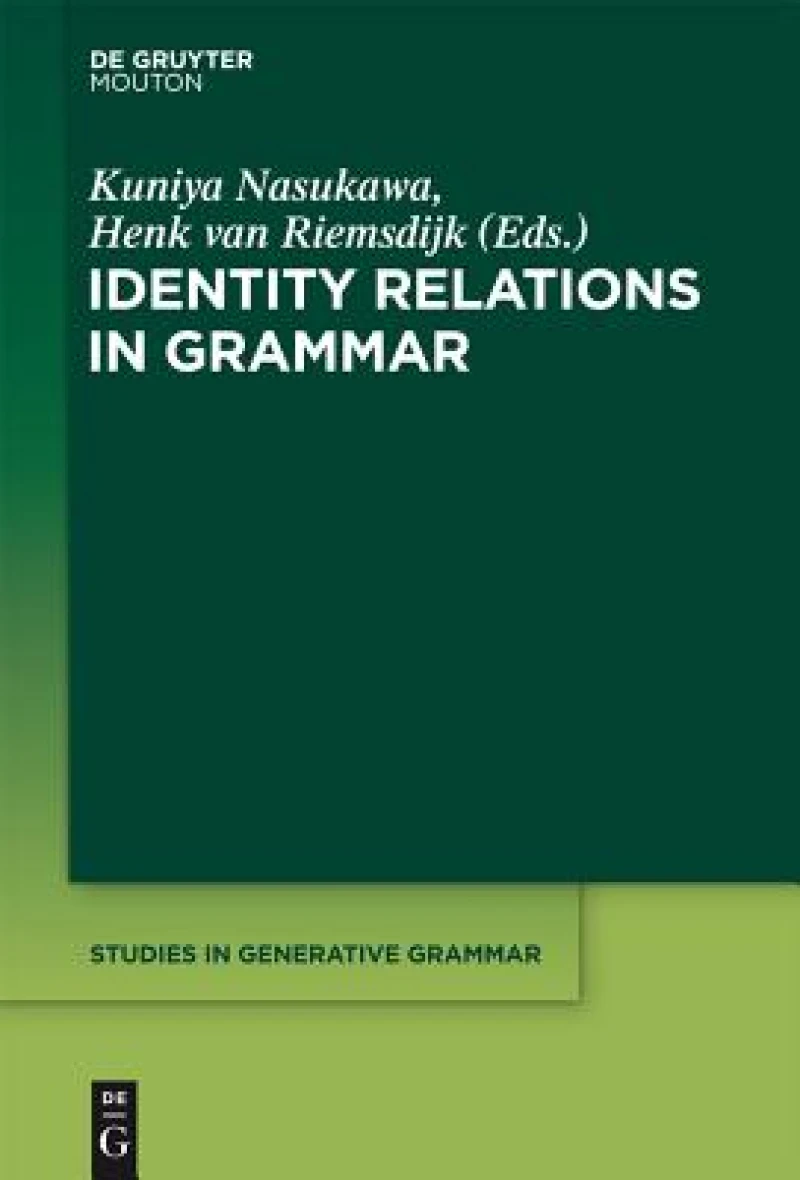
Identity Relations in Grammar
Book Details
Format
Hardback or Cased Book
Book Series
Studies in Generative Grammar [SGG]
ISBN-10
1614518181
ISBN-13
9781614518181
Publisher
De Gruyter
Imprint
De Gruyter Mouton
Country of Manufacture
GB
Country of Publication
GB
Publication Date
Jun 16th, 2014
Print length
381 Pages
Weight
670 grams
Product Classification:
Linguistics
Ksh 21,700.00
Werezi Extended Catalogue
0 in stock
Delivery Location
Delivery fee: Select location
Secure
Quality
Fast
Brings together research from a broad scale of domains of grammar that have a bearing on the role that identity plays in the structure of grammatical representations and principles.
Few concepts are as ubiquitous in the physical world of humans as that of identity. Laws of nature crucially involve relations of identity and non-identity, the act of identifying is central to most cognitive processes, and the structure of human language is determined in many different ways by considerations of identity and its opposite. The purpose of this book is to bring together research from a broad scale of domains of grammar that have a bearing on the role that identity plays in the structure of grammatical representations and principles. Beyond a great many analytical puzzles, the creation and avoidance of identity in grammar raise a lot of fundamental and hard questions. These include: Why is identity sometimes tolerated or even necessary, while in other contexts it must be avoided? What are the properties of complex elements that contribute to configurations of identity (XX)? What structural notions of closeness or distance determine whether an offending XX-relation exists or, inversely, whether two more or less distant elements satisfy some requirement of identity? Is it possible to generalize over the specific principles that govern (non-)identity in the various components of grammar, or are such comparisons merely metaphorical? Indeed, can we define the notion of identity in a formal way that will allow us to decide which of the manifold phenomena that we can think of are genuine instances of some identity (avoidance) effect? If identity avoidance is a manifestation in grammar of some much more encompassing principle, some law of nature, then how is it possible that what does and what does not count as identical in the grammars of different languages seems to be subject to considerable variation?
Get Identity Relations in Grammar by at the best price and quality guaranteed only at Werezi Africa's largest book ecommerce store. The book was published by De Gruyter and it has pages.

