
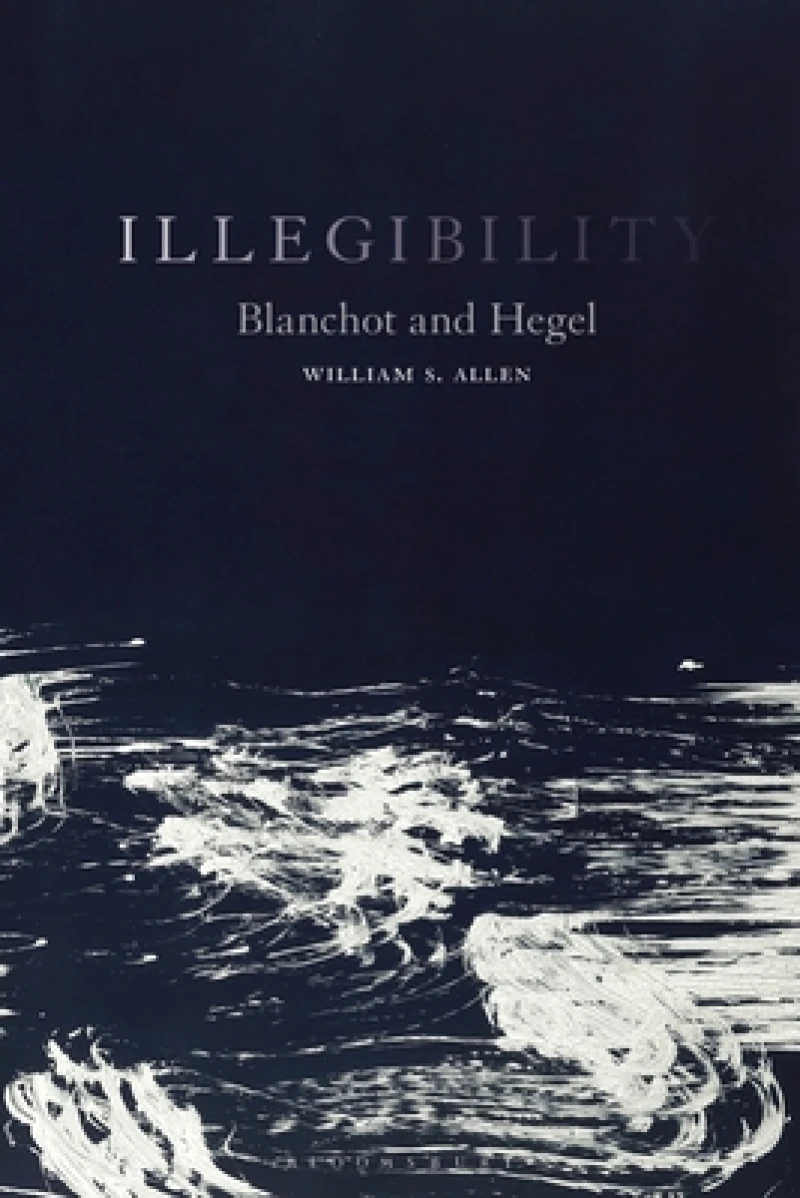
Illegibility : Blanchot and Hegel
Book Details
Format
Paperback / Softback
ISBN-10
1501376780
ISBN-13
9781501376788
Publisher
Bloomsbury Publishing Plc
Imprint
Bloomsbury Academic USA
Country of Manufacture
GB
Country of Publication
GB
Publication Date
Jan 26th, 2023
Print length
264 Pages
Weight
382 grams
Dimensions
15.10 x 22.70 x 1.90 cms
Product Classification:
Philosophy of languageLiterary essaysLiterary theoryPhilosophy of mind
Ksh 6,150.00
Manufactured on Demand
0 in stock
Delivery Location
Delivery fee: Select location
Secure
Quality
Fast
The philosophical significance of Maurice Blanchot’s writings has rarely been in doubt. Specifying the nature and implications of his thinking has proved much less easy, particularly in reference to the key figure of G. W. F. Hegel. Examination reveals that Blanchot’s thinking is persistently oriented towards a questioning of the terms of Hegel’s thought, while nevertheless remaining within its themes, whichshows how rigorously he studied Hegel’s works but also how radical his critique of them became. Equally, it allows for a crucial discussion of the differences between Blanchot’s responses to Hegel and those of Jacques Derrida, with the implicit suggestion that in some ways Blanchot’s critique of Hegel is more far-reaching than that developed by Derrida. William S. Allen demonstrates those aspects of Hegelian thought that permeate Blanchot’s writings and, in turn, develops a detailed three-way analysis of Derrida, Hegel, and Blanchot. The key question around which this analysis develops is that of the relation between thought and language concerning the issue of the infinite and its legibility. Illegibility introduces a new and substantially philosophical account of Blanchot’s importance, and also showshow his writings laid the ground for Derrida’s workswhile developing their own uniquely challenging response to the problems of post-Hegelian thought.
The philosophical significance of Maurice Blanchot’s writings has rarely been in doubt. Specifying the nature and implications of his thinking has proved much less easy, particularly in reference to the key figure of G. W. F. Hegel. Examination reveals that Blanchot’s thinking is persistently oriented towards a questioning of the terms of Hegel’s thought, while nevertheless remaining within its themes, whichshows how rigorously he studied Hegel’s works but also how radical his critique of them became. Equally, it allows for a crucial discussion of the differences between Blanchot’s responses to Hegel and those of Jacques Derrida, with the implicit suggestion that in some ways Blanchot’s critique of Hegel is more far-reaching than that developed by Derrida. William S. Allen demonstrates those aspects of Hegelian thought that permeate Blanchot’s writings and, in turn, develops a detailed three-way analysis of Derrida, Hegel, and Blanchot. The key question around which this analysis develops is that of the relation between thought and language concerning the issue of the infinite and its legibility. Illegibility introduces a new and substantially philosophical account of Blanchot’s importance, and also showshow his writings laid the ground for Derrida’s workswhile developing their own uniquely challenging response to the problems of post-Hegelian thought.
Get Illegibility by at the best price and quality guaranteed only at Werezi Africa's largest book ecommerce store. The book was published by Bloomsbury Publishing Plc and it has pages.

