
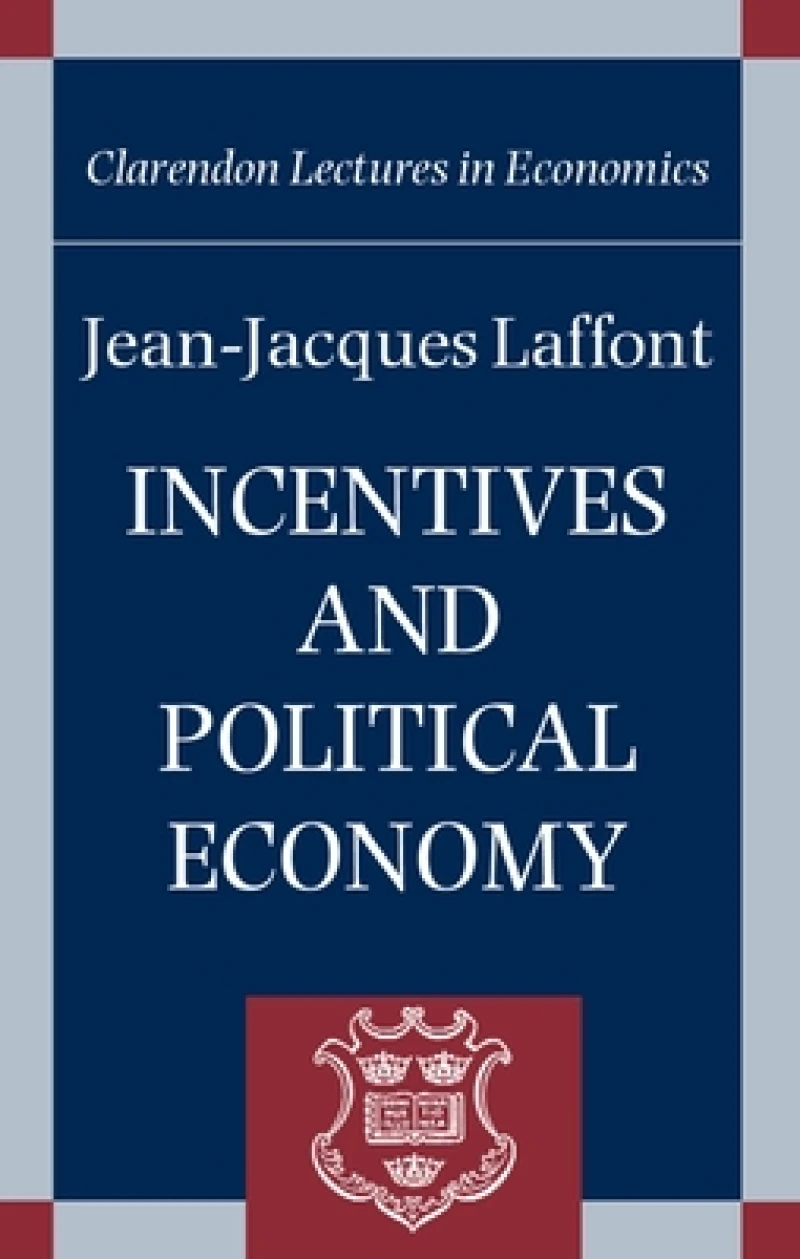
Incentives and Political Economy
Book Details
Format
Paperback / Softback
Book Series
Clarendon Lectures in Economics
ISBN-10
0199248680
ISBN-13
9780199248681
Publisher
Oxford University Press
Imprint
Oxford University Press
Country of Manufacture
GB
Country of Publication
GB
Publication Date
Oct 18th, 2001
Print length
272 Pages
Weight
368 grams
Dimensions
21.60 x 13.90 x 1.70 cms
Product Classification:
Central governmentPolitical economy
Ksh 12,300.00
Manufactured on Demand
0 in stock
Delivery Location
Delivery fee: Select location
Secure
Quality
Fast
'Incentives and Political Economy' constructs a normative approach to constitutional design using developments in contract theory. It treats political economy as the study of the incentive problems created by the delegation of Politicians are treated successively as informed supervisors or residual decision-makers.
Mainstream economics has only recently recognized the need to incorporate political constraints into economic analysis intended for policy advisors. "Incentives and Political Economy" uses recent advances in contract theory to build a normative approach to constitutional design in economic environments. It is written by one of Europe''s leading theorists. The first part of the book remains in the tradition of benevolent constitutional design with complete contracting. It treats politicians as informed supervisors and studies how the Constitution should control them, in particular to avoid capture by interest groups. Incentive theories for the separation of powers or systems of checks and balances are developed. The second part of the book recognizes the incompleteness of the constitutional contract which leaves a lot of discretion to the politicians selected by the electoral process. Asymmetric information associates information rents with economic policies and the political game becomes a game of costly redistribution of those rents. Professor Laffont investigates the trade-offs between an inflexible constitution which leaves little discretion to politicians but sacrifices ex post efficiency and a constitution weighted towards ex post efficiency but also giving considerable discretion to politicians to pursue private agendas. The final part of the book reconsiders the modeling of collusion given asymmetric information. It proposes a new approach to characterizing incentives constraints for group behaviour when asymmetric information is non-verifiable. This provides a methodology to characterize the optimal constitutional response to activities of interest groups and to study the design of any institutions in which group behavior is important.
Get Incentives and Political Economy by at the best price and quality guaranteed only at Werezi Africa's largest book ecommerce store. The book was published by Oxford University Press and it has pages.

