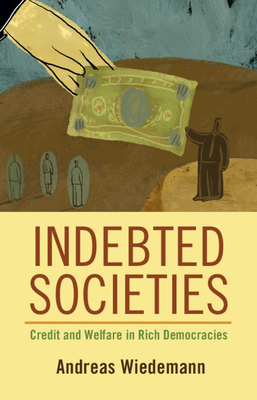
Indebted Societies : Credit and Welfare in Rich Democracies
Book Details
Format
Paperback / softback
Book Series
Cambridge Studies in Comparative Politics
ISBN-10
110897158X
ISBN-13
9781108971584
Publisher
Cambridge University Press
Imprint
Cambridge University Press
Country of Manufacture
US
Country of Publication
GB
Publication Date
Jul 8th, 2021
Print length
346 Pages
Weight
524 grams
Dimensions
15.20 x 22.80 x 2.40 cms
Product Classification:
SociologySocial welfare & social servicesSocial welfare, social policy and social servicesPolitics & governmentPolitics and governmentComparative politicsInternational institutions / intergovernmental organizationsEU & European institutionsPolitical economyWelfare economicsWelfare economics
KSh 6,400.00
Currently unavailable
0 in stock
Delivery Location
Delivery fee: Select location
Secure
Quality
Fast
This book introduces a social policy theory of everyday borrowing to examine how the rise of credit as a private alternative to the welfare state creates a new kind of social and economic citizenship. It is for scholars across the social sciences who study financialization, comparative political economy, and inequality.
In many rich democracies, access to financial markets is now a prerequisite for fully participating in labor and housing markets and pursuing educational opportunities. Indebted Societies introduces a new social policy theory of everyday borrowing to examine how the rise of credit as a private alternative to the welfare state creates a new kind of social and economic citizenship. Andreas Wiedemann provides a rich study of income volatility and rising household indebtedness across OECD countries. Weaker social policies and a flexible knowledge economy have increased costs for housing, education, and raising a family - forcing many people into debt. By highlighting how credit markets interact with welfare states, the book helps explain why similar groups of people are more indebted in some countries than others. Moreover, it addresses the fundamental question of whether individuals, states, or markets should be responsible for addressing socio-economic risks and providing social opportunities.
Get Indebted Societies by Andreas Wiedemann at the best price and quality guaranteed only at Werezi Africa's largest book ecommerce store. The book was published by Cambridge University Press and it has 346 pages.
Customers Who Bought This Also Bought

Caste
KSh 2,700.00

On Freedom
KSh 2,350.00

Extinction of Experience
KSh 3,950.00

Revenge of the Tipping Point
KSh 2,350.00

Lost Girls
KSh 2,000.00

Right to Sex
KSh 2,000.00

Caste
KSh 4,550.00

Revenge of the Tipping Point
KSh 4,500.00

Revenge of the Tipping Point
KSh 3,050.00

Can Feminism Be African
KSh 2,000.00

Can Feminism Be African
KSh 3,950.00

History of Sexuality: 2
KSh 2,350.00