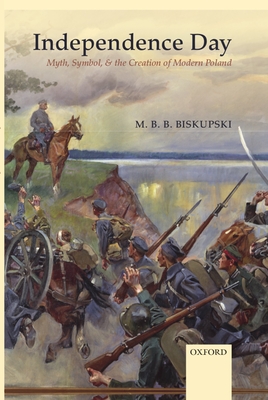
Independence Day : Myth, Symbol, and the Creation of Modern Poland
Book Details
Format
Hardback
ISBN-10
0199658811
ISBN-13
9780199658817
Publisher
Oxford University Press
Imprint
Oxford University Press
Country of Manufacture
GB
Country of Publication
GB
Publication Date
Sep 13th, 2012
Print length
224 Pages
Weight
476 grams
Dimensions
24.00 x 16.00 x 1.90 cms
Product Classification:
European history20th century history: c 1900 to c 2000Social & cultural historyHistory of ideas
KSh 27,550.00
Temporarily out of stock, due soon
0 in stock
Delivery Location
Delivery fee: Select location
Secure
Quality
Fast
A discussion of how modern Poland was created by the application and manipulation of myths about its past, and the symbols that represented them.
The 11th of November 1918, Polish Independence Day, is a curious anniversary whose commemoration has been only intermittently observed in the last century. In fact, the day -- and the several symbols that rightly or wrongly have become associated with it -- has a rather convoluted history, filled with tradition and myth, which deserves attention.Independence Day is more than just the history of a day, or the evolution of its celebration, but an explanation of what meaning has come to be associated with that date. It offers a re-reading of Polish history, not by a series of dates, but through a series of symbols whose combination allows the Poles to understand who they are by what they have been. Its focus is on the era 1914-2008, and the central actor is the charismatic Jozef Pilsudski. He came to represent a disposition regarding the meaning of Polish history which eventually penetrated virtually all of modern Polish society. The work is constructed by the analysis of memoirs, documents, coins, stamps, films, maps, monuments, and many other features making it a multi-disciplinary and multi-dimensional volume.
Get Independence Day by M. B. B. Biskupski at the best price and quality guaranteed only at Werezi Africa's largest book ecommerce store. The book was published by Oxford University Press and it has 224 pages.
Customers Who Bought This Also Bought

Age of Revolutions
KSh 2,350.00

Eichmann in Jerusalem
KSh 2,350.00

Trouble With Being Born
KSh 2,000.00

Hiroshima
KSh 2,000.00

Freedom
KSh 6,300.00
Holocaust
KSh 2,700.00
The History of the Peloponnesian War
KSh 2,700.00
Annals
KSh 2,350.00
Greek Lives
KSh 2,150.00
Sleepwalkers
KSh 3,400.00

Napoleon The Great
KSh 3,600.00
Diary of a Young Girl
KSh 1,800.00