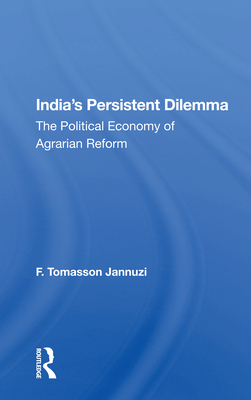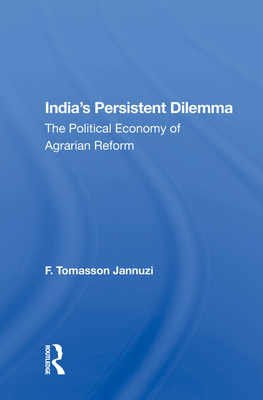
India''s Persistent Dilemma : The Political Economy of Agrarian Reform
Book Details
Format
Hardback
ISBN-10
0367016761
ISBN-13
9780367016760
Publisher
Taylor & Francis Ltd
Imprint
Routledge
Country of Manufacture
GB
Country of Publication
GB
Publication Date
Jun 7th, 2019
Print length
256 Pages
Weight
453 grams
Product Classification:
Politics & governmentPolitics and government
KSh 30,950.00
Currently unavailable
0 in stock
Delivery Location
Delivery fee: Select location
Secure
Quality
Fast
This study shows that the failure of successive Indian governments to effect meaningful agrarian reforms has led to a political economy in rural India that is shaped, as it was prior to independence, largely by the interests of an elite minority of landholders. This group, Jannuzi argues, has worked both to deny the socioeconomic changes promised by modern India''s own founders and to thwart the needs and interests of the rural majority who continue to lack secure rights in land. Examining the government''s inability to establish a coherent national program for agrarian reform, the author focuses on the failure of a process that, on the one hand, has guaranteed India''s landholding elites strong and continuous representation in the shaping of such agrarian reforms as were legislated and partially implemented and, on the other, has given no meaningful voice to the people at the base of what he calls "the hierarchy of interests in land" in rural India. The author skillfully interweaves three major themes: (1) the remarkable continuity in the thinking of policy makers in both colonial and independent India as they struggled to articulate and promote agrarian policies; (2) the persistence of economic arguments for agrarian reform that emphasize the idea that large units of cultivation offer inherent productive efficiency advantages over small holdings; and (3) the role of both British and Indian decision makers in maintaining a conceptual dichotomy between the issue of increasing productivity and the issue of distributive justice. Noting the expanding political participation of India''s rural poor as well as the continuing need for increased agricultural productivity, Jannuzi asserts that future Indian leaders must emphasize the complementarity of the goals of productivity growth and distributive justice. As they seek to form a political nexus with the rural majority, future leaders will be challenged to implement agrarian policies that actually transform the political econ
Get India''s Persistent Dilemma by F. Tomasson Jannuzi at the best price and quality guaranteed only at Werezi Africa's largest book ecommerce store. The book was published by Taylor & Francis Ltd and it has 256 pages.
Customers Who Bought This Also Bought
Regime Change
KSh 5,050.00

Art of War / The Book of Lord Shang
KSh 1,100.00

Wretched of the Earth
KSh 2,000.00

White Saviorism In International Development
KSh 3,800.00
How To Do Nothing
KSh 2,700.00

How Civil Wars Start
KSh 2,000.00

Tomorrow Is Yesterday
KSh 4,700.00

The Thinking Machine
KSh 2,350.00

Second Treatise of Government – Norton Library
KSh 1,600.00

Becoming
KSh 2,350.00

A River in Darkness
KSh 1,250.00
Warning to the West
KSh 1,600.00