
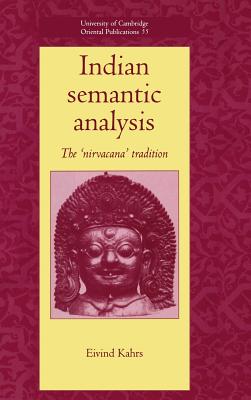
Indian Semantic Analysis : The Nirvacana Tradition
by
Eivind Kahrs
Book Details
Format
Hardback
Book Series
University of Cambridge Oriental Publications
ISBN-10
0521631882
ISBN-13
9780521631884
Publisher
Cambridge University Press
Imprint
Cambridge University Press
Country of Manufacture
GB
Country of Publication
GB
Publication Date
Mar 28th, 1999
Print length
322 Pages
Weight
660 grams
Dimensions
22.90 x 15.20 x 1.90 cms
KSh 17,800.00
Currently unavailable
0 in stock
Delivery Location
Delivery fee: Select location
Secure
Quality
Fast
In a searching analysis, the author examines the Indian tradition of semantic elucidation known as nirvacana analysis. The book will be an important reference tool for students of Sanskrit and Indian studies, as well as for those in the field of indigenous Indian linguistics.
The Indian tradition of semantic elucidation known as nirvacana analysis represented a powerful hermeneutic tool in the exegesis and transmission of authoritative scripture. Nevertheless, it has all too frequently been dismissed by modern scholars as anything from folk-etymology to a primitive forerunner of historical linguistics. Eivind Kahrs argues that such views fall short of explaining both its acceptance within the sophisticated grammatical tradition of vyakarana and its effective usage in the processing of Sanskrit texts. He establishes his argument by investigating the learned Sanskrit literature of Saiva Kashmir and explains the nirvacana tradition in the light of a model substitution, used at least since the time of the Upanisads and later refined in the technical literatures of grammar and ritual. According to this model, a substitute (adesa) takes the place (sthana) of the original placeholder (sthanin). On the basis of a searching analysis of Sanskrit texts, the author argues that this sthana 'place' can be interpreted as 'meaning', the model thereby providing favourable circumstances for reinterpretation and change.
Get Indian Semantic Analysis by Eivind Kahrs at the best price and quality guaranteed only at Werezi Africa's largest book ecommerce store. The book was published by Cambridge University Press and it has 322 pages.
Customers Who Bought This Also Bought

On Great Writing (On the Sublime)
KSh 2,000.00

Look Again: Empire
KSh 1,800.00
The Art of Rhetoric
KSh 2,000.00
The Role of the Reader
KSh 3,400.00

Six Walks in the Fictional Woods
KSh 4,850.00
The Language of Literature
KSh 3,450.00
The Sign of Three
KSh 3,250.00
The Limits of Interpretation
KSh 12,200.00

Die philippischen Reden
KSh 22,250.00
Walker Percy''s Search for Community
KSh 5,950.00
Voice of Deliverance
KSh 6,450.00

Community and Critique
KSh 10,800.00
