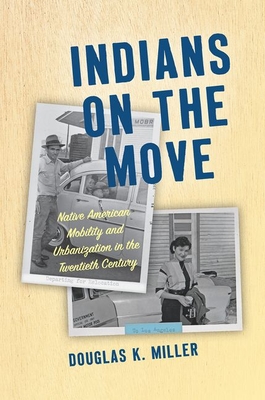
Indians on the Move : Native American Mobility and Urbanization in the Twentieth Century
Book Details
Format
Hardback
Book Series
Critical Indigeneities
ISBN-10
1469651378
ISBN-13
9781469651378
Publisher
The University of North Carolina Press
Imprint
The University of North Carolina Press
Country of Manufacture
GB
Country of Publication
GB
Publication Date
Apr 22nd, 2019
Print length
272 Pages
Weight
548 grams
Dimensions
23.30 x 15.50 x 1.90 cms
KSh 14,200.00
Currently unavailable
0 in stock
Delivery Location
Delivery fee: Select location
Secure
Quality
Fast
In 1972, the Bureau of Indian Affairs terminated its twenty-year-old Voluntary Relocation Program. At the time the program ended, many groups had already classified it as a failure. Douglas Miller here argues that a richer story should be told - one that recognises Indigenous mobility in terms of its benefits and not merely its costs.
In 1972, the Bureau of Indian Affairs terminated its twenty-year-old Voluntary Relocation Program, which encouraged the mass migration of roughly 100,000 Native American people from rural to urban areas. At the time the program ended, many groups-from government leaders to Red Power activists-had already classified it as a failure, and scholars have subsequently positioned the program as evidence of America''s enduring settler-colonial project. But Douglas K. Miller here argues that a richer story should be told-one that recognizes Indigenous mobility in terms of its benefits and not merely its costs. In their collective refusal to accept marginality and destitution on reservations, Native Americans used the urban relocation program to take greater control of their socioeconomic circumstances. Indigenous migrants also used the financial, educational, and cultural resources they found in cities to feed new expressions of Indigenous sovereignty both off and on the reservation.
The dynamic histories of everyday people at the heart of this book shed new light on the adaptability of mobile Native American communities. In the end, this is a story of shared experience across tribal lines, through which Indigenous people incorporated urban life into their ideas for Indigenous futures.
The dynamic histories of everyday people at the heart of this book shed new light on the adaptability of mobile Native American communities. In the end, this is a story of shared experience across tribal lines, through which Indigenous people incorporated urban life into their ideas for Indigenous futures.
Get Indians on the Move by Douglas K. Miller at the best price and quality guaranteed only at Werezi Africa's largest book ecommerce store. The book was published by The University of North Carolina Press and it has 272 pages.
Customers Who Bought This Also Bought

Crusade for Justice – The Autobiography of Ida B. Wells, Second Edition
KSh 4,050.00

Killers of the Flower Moon
KSh 2,000.00

Warmth of Other Suns
KSh 3,050.00

Frederick Douglass
KSh 3,350.00

107 Days
KSh 4,500.00

Second Treatise of Government – Norton Library
KSh 1,600.00

Tuesdays With Morrie
KSh 2,000.00
My Bondage and My Freedom
KSh 1,600.00

Hidden Figures
KSh 2,000.00

America, América
KSh 3,650.00

Holding the Line
KSh 2,000.00

Nuclear Folly
KSh 3,050.00