
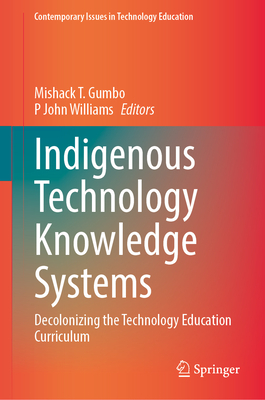
Indigenous Technology Knowledge Systems : Decolonizing the Technology Education Curriculum
2023 ed.
Book Details
Format
Hardback
Book Series
Contemporary Issues in Technology Education
ISBN-10
9819913950
ISBN-13
9789819913954
Edition
2023 ed.
Publisher
Springer Verlag, Singapore
Imprint
Springer Verlag, Singapore
Country of Manufacture
GB
Country of Publication
GB
Publication Date
Jun 20th, 2023
Print length
331 Pages
Weight
704 grams
Dimensions
16.40 x 24.20 x 2.60 cms
KSh 25,200.00
Currently unavailable
0 in stock
Delivery Location
Delivery fee: Select location
Secure
Quality
Fast
ITKSE also presents opportunities for technology teachers to reflect on and revisit their depth of technological knowledge, pedagogies, and assessment. The intent of this bookis transformational in the sense that it brings decolonial and indigenous perspectives into the technology education context.
There has been a growing interest in indigenous knowledge systems and research. This interest has been mainly triggered by the need to decolonize education as a response to the colonial onslaught on indigenous knowledge and people. Research has, however, concentrated on the generality of the indigenous knowledge system rather than on its related dimensions. One area that has suffered a lack of attention is indigenous conceptions of science, technology, engineering, and mathematics (STEM) despite the unquestionable evidence of STEM in indigenous contexts. Most STEM is presented by colonial establishments and representations, especially in developed/modern/urban contexts, which portray STEM as a colonial construct. This book focuses on indigenous technological knowledge systems education (ITKSE). Indigenous people have been at the front of technological developments from pre-colonial times. The list of precolonial industries, science, and technology is extensive, including blacksmithing, wood-carving, textile-weaving and dyeing, leather works, beadworks, pottery making, architecture, agricultural breeding, metal-working, salt production, gold-smithing, copper-smithing, leather-crafting, soap-making, bronze-casting, canoe-building, brewing, glass-making, and agriculture, for example. In some parts of the world such as Africa and Australia, these technologies still exist. ITKSE should not be left to exist outside of the technology education curriculum and classroom as it can benefit both indigenous students, who have been denied learning about what is relevant to them, and non-indigenous students. These cultural groups can expand their knowledge of technology by learning both ITKSE and Western technological knowledge systems education (WTKSE). ITKSE also presents opportunities for technology teachers to reflect on and revisit their depth of technological knowledge, pedagogies, and assessment. The intent of this bookis transformational in the sense that it brings decolonial and indigenous perspectives into the technology education context. It extends technology education in the sense that it will not only influence Western-minded architects, artisans, designers, etc. but encourage indigenous-mindedness as well.
Get Indigenous Technology Knowledge Systems by Mishack T. Gumbo at the best price and quality guaranteed only at Werezi Africa's largest book ecommerce store. The book was published by Springer Verlag, Singapore and it has 331 pages.
Customers Who Bought This Also Bought

Caste
KSh 2,700.00

On Freedom
KSh 2,350.00

Extinction of Experience
KSh 3,950.00

Revenge of the Tipping Point
KSh 2,350.00

Lost Girls
KSh 2,000.00

Right to Sex
KSh 2,000.00
Caste
KSh 4,550.00

Revenge of the Tipping Point
KSh 4,500.00

Revenge of the Tipping Point
KSh 3,050.00

Can Feminism Be African
KSh 2,000.00

Can Feminism Be African
KSh 3,950.00

History of Sexuality: 2
KSh 2,350.00
