
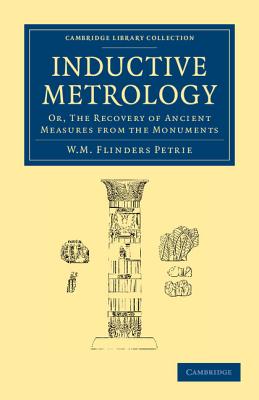
Inductive Metrology : Or, The Recovery of Ancient Measures from the Monuments
Book Details
Format
Paperback / softback
Book Series
Cambridge Library Collection - Egyptology
ISBN-10
1108065767
ISBN-13
9781108065764
Publisher
Cambridge University Press
Imprint
Cambridge University Press
Country of Manufacture
GB
Country of Publication
GB
Publication Date
Sep 5th, 2013
Print length
176 Pages
Weight
238 grams
Dimensions
13.80 x 21.60 x 1.30 cms
Product Classification:
Archaeology by period / regionArchaeology by period / region
KSh 4,400.00
Currently unavailable
0 in stock
Delivery Location
Delivery fee: Select location
Secure
Quality
Fast
As a young man, Sir William Matthew Flinders Petrie (1853–1942) published in 1877 this innovative approach to metrology, based on his early surveying experiences. It analyses monuments from a range of civilisations to determine their methods of linear measurement. Notably, Petrie establishes that societies without writing systems could also make accurate measurements.
Among the leading Egyptologists of his day, Sir William Matthew Flinders Petrie (1853–1942) excavated over fifty sites and trained a generation of archaeologists. As a young man, he demonstrated an aptitude for mathematics and used this skill to measure monuments across the south of England, including Stonehenge. Published in 1877, this work was based in part on these early surveys and provides great insight into the linear measurements used by ancient civilisations. Notably, Petrie establishes that accurate measurement was possible in societies without writing systems. His innovative approach to metrology draws comparisons between units of measurement used by peoples separated by great spans of time and distance, ranging from medieval Ireland to ancient Egypt. Petrie went on to write prolifically throughout his long career, and a great many of his other publications are also reissued in this series.
Get Inductive Metrology by William Matthew Flinders Petrie at the best price and quality guaranteed only at Werezi Africa's largest book ecommerce store. The book was published by Cambridge University Press and it has 176 pages.
Customers Who Bought This Also Bought
Andean Expressions
KSh 6,350.00

Forgotten
KSh 2,000.00
Ocmulgee Archaeology, 1936-1986
KSh 6,700.00
Mound Sites of the Ancient South
KSh 7,950.00

The Limits of Tyranny
KSh 11,500.00
Conquistador’s Wake
KSh 22,600.00
The Ancient Maya, 6th Edition
KSh 7,400.00
The Punic Mediterranean
KSh 21,600.00
The Palace of Minos
KSh 14,250.00
The Penetration of Arabia
KSh 8,300.00
Chogha Mish, Volume 2
KSh 15,300.00
A Primer of Assyriology
KSh 3,800.00
More by William Matthew Flinders Petrie
The Revolutions of Civilisation
KSh 4,000.00

Dendereh 1898
KSh 5,500.00

Naukratis I and II, Hawara, Biahmu, and Arsinoe
KSh 8,850.00

Tanis
KSh 8,650.00
A History of Egypt
KSh 5,500.00
Tell El-Amarna
KSh 5,000.00

Seventy Years in Archaeology
KSh 6,600.00

Six Temples at Thebes, Naqada and Ballas
KSh 6,200.00

The Religion of Ancient Egypt
KSh 4,100.00
Roman Portraits and Memphis IV, Tarkhan I and Memphis V, Tarkhan II
KSh 7,800.00
Researches in Sinai
KSh 8,000.00

Memphis I, The Palace of Apries (Memphis II), Meydum and Memphis III
KSh 6,800.00
