
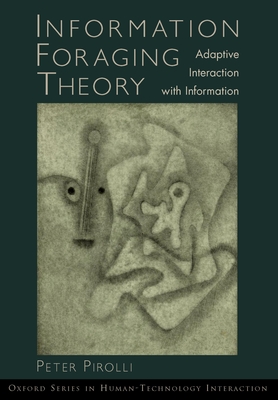
Information Foraging Theory : Adaptive Interaction with Information
Book Details
Format
Paperback / softback
Book Series
Human Technology Interaction Series
ISBN-10
0195387791
ISBN-13
9780195387797
Publisher
Oxford University Press Inc
Imprint
Oxford University Press Inc
Country of Manufacture
US
Country of Publication
GB
Publication Date
Apr 8th, 2010
Print length
224 Pages
Weight
480 grams
Dimensions
17.80 x 25.30 x 1.30 cms
KSh 9,700.00
Currently unavailable
0 in stock
Delivery Location
Delivery fee: Select location
Secure
Quality
Fast
Although much of the hubris and hyperbole surrounding the 1990''s Internet has softened to a reasonable level, the inexorable momentum of information growth continues unabated. This wealth of information provides resources for adapting to the problems posed by our increasingly complex world, but the simple availability of more information does not guarantee its successful transformation into valuable knowledge that shapes, guides, and improves our activity. When faced with something like the analysis of sense-making behavior on the web, traditional research models tell us a lot about learning and performance with browser operations, but very little about how people will actively navigate and search through information structures, what information they will choose to consume, and what conceptual models they will induce about the landscape of cyberspace. Thus, it is fortunate that a new field of research, Adaptive Information Interaction (AII), is becoming possible. AII centers on the problems of understanding and improving human-information interaction. It is about how people will best shape themselves to their information environments, and how information environments can best be shaped to people. Its roots lie in human-computer interaction (HCI), information retrieval, and the behavioral and social sciences. This book is about Information Foraging Theory (IFT), a new theory in Adaptive Information Interaction that is one example of a recent flourish of theories in adaptationist psychology that draw upon evolutionary-ecological theory in biology. IFT assumes that people (indeed, all organisms) are ecologically rational, and that human information-seeking mechanisms and strategies adapt the structure of the information environments in which they operate. Its main aim is to create technology that is better shaped to users. Information Foraging Theory will be of interest to student and professional researchers in HCI and cognitive psychology.
Get Information Foraging Theory by Peter L. T. Pirolli at the best price and quality guaranteed only at Werezi Africa's largest book ecommerce store. The book was published by Oxford University Press Inc and it has 224 pages.
Customers Who Bought This Also Bought

The Culture Map
KSh 3,050.00

Abundance
KSh 2,150.00

Think Again
KSh 2,000.00

Amusing Ourselves to Death
KSh 2,000.00

The Sane Society
KSh 3,500.00

Abundance
KSh 3,050.00
Art of Gathering
KSh 2,150.00

The Anxious Generation
KSh 2,000.00

How To Know a Person
KSh 2,350.00

Righteous Mind
KSh 2,700.00
Outliers
KSh 1,250.00

Persuaders
KSh 3,600.00
